Chilkey ND65 vs Keychron Lemokey P1Compact Wireless vs Feature-Rich 75%
Choose the Chilkey ND65 for maximum portability and battery life, or the Keychron P1 for superior software customization and a more functional layout.
KeebFinder may earn a commission when you buy through these links, at no extra cost to you.

No reviews
from$75at MK

5.0 (10)5.0 · 10 reviews
from$104at Keychron
Which one should you get?
Get the
Chilkey ND65
Compact Wireless
Build quality in the top 30% of 65% boards under $100.
- Larger 6000mAh battery for extended wireless use.
- More compact 65% layout for a smaller desk footprint.
- Includes north-facing RGB LEDs, which can avoid interference with certain Cherry-profile keycaps.
- North-facing LEDs. Cherry-profile keycaps can hit the switch housing.
- No ISO layout. ISO-DE, UK, and other ISO variants are not offered.
- 65% layout. No function row and no numpad.
Get the
Keychron Lemokey P1
Feature-Rich 75%
Build quality in the top 5% of 75% boards under $150.
- Extensive programmability with QMK, VIA, and the Lemokey Launcher web app support.
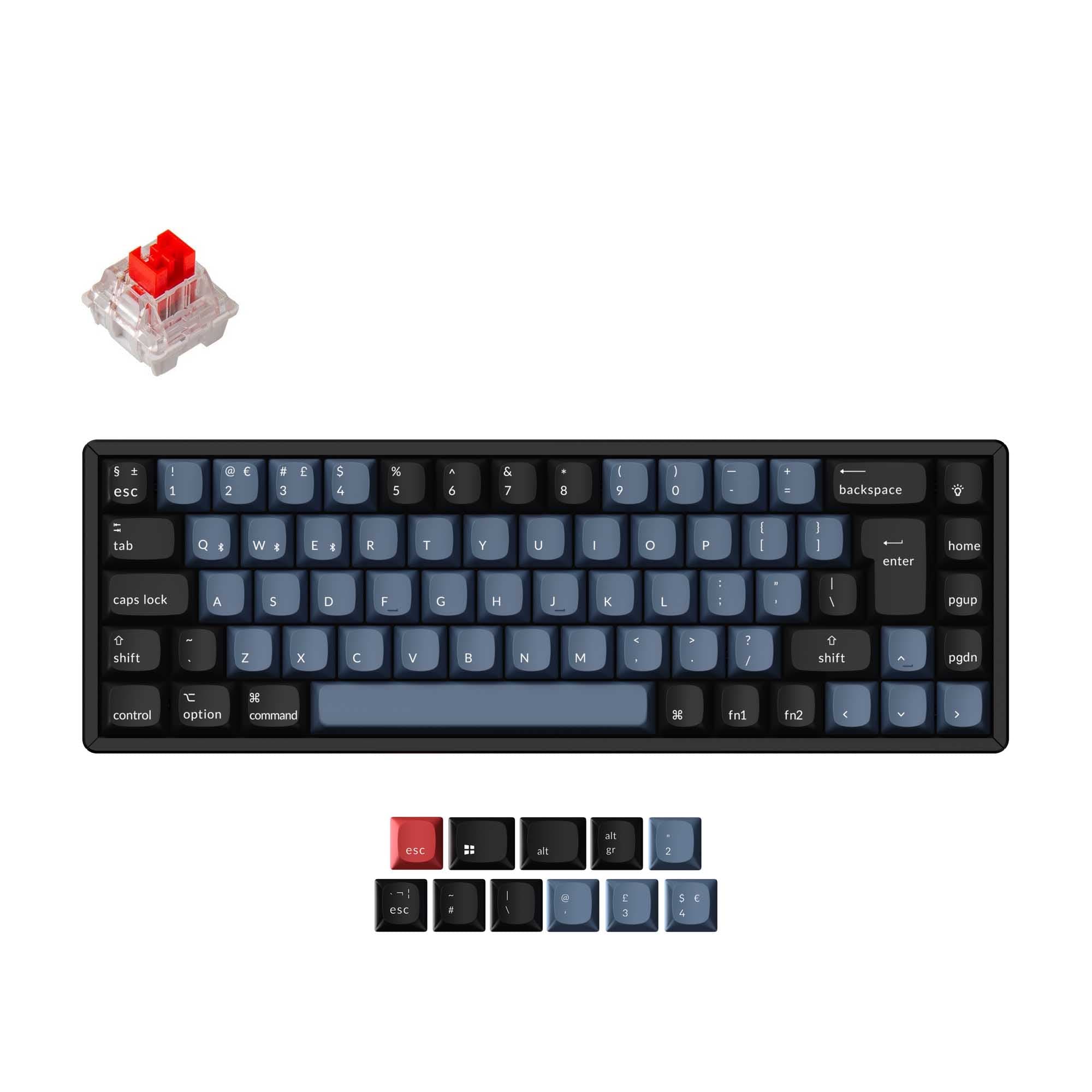
- 75% layout includes arrow keys, function row, and a macro column with a knob.
- Wide international layout support, including multiple ISO variants.
- South-facing LEDs. Shine-through legends stay dark, and some sculpted keycaps can clip the LED.
- No numpad.
Your priority should guide this choice. If your main need is a highly portable, long-lasting wireless keyboard for use on the go, the Chilkey ND65 is the clear pick. For nearly every other scenario—especially if you value deep customization, software support, and a more functional layout with extra controls—the Keychron P1 offers significantly more capability and is the recommended choice despite its higher cost and larger size.
The differences that matter
Skip the 40-row spec sheet. These are the specs that change how each board feels, sounds, and fits your desk.
Chilkey ND65
Keychron Lemokey P1
Layout size
65%
75%
Connection
Bluetooth, Wired, 2.4 GHz
Bluetooth, 2.4 GHz, Wired
Wireless for several devices and wired for lower latency
Battery
6,000 mAh
4,000 mAh
A larger battery means fewer cables during the day
Case material
Aluminum, Plastic
Aluminum
Switch options
Clicky, Linear
Clicky, Linear, Tactile
- Chilkey ND65
- Keychron Lemokey P1
- Performance
- 5581
- Build quality
- 7688
- Productivity
- 7097
- Customizability
- 6896
- Portability
- 9481
- Hot-swappable
- Max polling rate: 1,000 Hz
- Plate material: Polycarbonate
- Keycaps: PBT
What will you mostly use it for?
The Keychron P1 is the more versatile choice, winning in five of six categories. Its strengths in software, layout, and extra controls make it better for gaming, office work, programming, modding, and content creation. The Chilkey ND65's primary advantage is for travel, where its smaller 65% form factor and larger battery offer tangible benefits for mobility. For stationary, feature-focused use, the P1 is consistently stronger.
Pick the Keychron Lemokey P1
- The Keychron P1 lists a 1000 Hz polling rate on its 2.4 GHz wireless connection, matching its wired performance for low latency.
- It includes a macro column and programmable knob, which the manufacturer states can be customized for gaming commands.
- The P1's listing mentions N-key rollover for both wireless and wired modes.
Chilkey ND65 vs Keychron Lemokey P1 specs
Every tracked spec, side by side. Rows marked with a dot differ between the boards.
13 of 26 specs differ
Chilkey ND65
Keychron Lemokey P1
Switch options
Hot-swappable
Mount style
Sound dampening
Screw-in stabilizers
Layout size
Layout standard
Ergonomics
Knob
Display
Connection
Max polling rate
Battery
USB-C
Case material
Plate material
Keycaps
Weight
Dimensions
Typing angle
Backlight
QMK
VIA
N-key rollover
Mac & Windows
Released
ISO layouts by store
Which stores sell ISO-DE, UK, and the other regional layouts.
Chilkey ND65
No ISO layout at the stores we track.
Keychron Lemokey P1
Keychron
ISO-DE, ISO-UK, ISO-Nordic, ISO-SW
In stockShips to you
Keychron (DE)
ISO
In stockDoes not ship to you
Keychron (DE)
ISO-DE, ISO-UK, ISO-Nordic, ISO-SW
In stockDoes not ship to you
Compare prices
Live prices from the stores we track, cheapest in-stock offer first.
Prices in USD are converted to your currency and can change at any time. KeebFinder may earn a commission when you buy through these links, at no extra cost to you.
Lowest price across stores, Amazon excluded.




Chilkey ND65 vs Keychron Lemokey P1: your questions
The Chilkey ND65 has a larger 6000mAh battery, while the Keychron P1 has a 4000mAh battery. Based on the listed capacities, the ND65 should theoretically offer longer usage between charges, which is a key advantage for wireless portability.
The vendor description for the Chilkey ND65 does not mention support for QMK, VIA, or any other key remapping software. The Keychron P1, in contrast, explicitly lists support for QMK, VIA, and its own Lemokey Launcher web app for extensive reprogramming.
The Chilkey ND65 uses north-facing LEDs, which shine from the top of the switch. The Keychron P1 uses south-facing LEDs, which shine from the bottom. South-facing LEDs can prevent interference with the stems of certain Cherry-profile keycaps, while north-facing LEDs may provide better illumination for shine-through keycap legends.
Yes, the Keychron P1 includes an aluminum rotary encoder (knob). According to the manufacturer, this knob can be programmed for various functions, including volume control, zoom, or adjusting screen brightness.
Both keyboards are listed as compatible with Mac and Windows systems. The Keychron P1 includes extra complimentary keycaps for Mac modifiers, and its software, Lemokey Launcher, is stated to work on macOS, Windows, and Linux.
The Chilkey ND65 uses plate-mount stabilizers according to its vendor page. The Keychron P1 uses screw-in PCB stabilizers, which are generally easier to tune and modify for a smoother, less rattly feel on large keys.
Yes, the Keychron P1 is available in a 'Barebone' kit version, which does not include switches or keycaps. This allows you to choose your own components. The Chilkey ND65 is only listed as a pre-built option.
The Keychron P1 offers extensive ISO layout support, including specific kits for UK, German, Nordic, and Swiss layouts, as well as a barebone ISO option. The Chilkey ND65 is listed with ANSI layout support only.
Yes, both keyboards feature a 1000Hz polling rate in their wired modes. The Keychron P1 Pro (wireless version) also maintains a 1000Hz polling rate on its 2.4 GHz wireless connection, according to its specifications.
The Chilkey ND65 comes with Kailh Blue Lotus linear switches. The fully assembled Keychron P1 comes with Keychron Super switches, which are available in linear (Red), tactile (Brown), and tactile with a pre-travel bump (Banana) variants.
The Keychron P1 listing specifically mentions the inclusion of multiple acoustic foams (IXPE, PET, absorbing foam) for sound dampening. The Chilkey ND65 description does not highlight any specific sound-dampening materials, though its gasket mount design may provide some cushioning.
Not sold on either?




Still torn?
Answer a few quick questions and the keyboard finder ranks 2,000+ boards by how you will actually use yours.