Filco Majestouch Xacro M10SP vs Mistel Barocco Split
Get the Filco for its 10 dedicated macro keys, programmable layers, and USB pass-through; choose the Mistel for its 1000 Hz polling and halves that can be joined or separated.
KeebFinder may earn a commission when you buy through these links, at no extra cost to you.
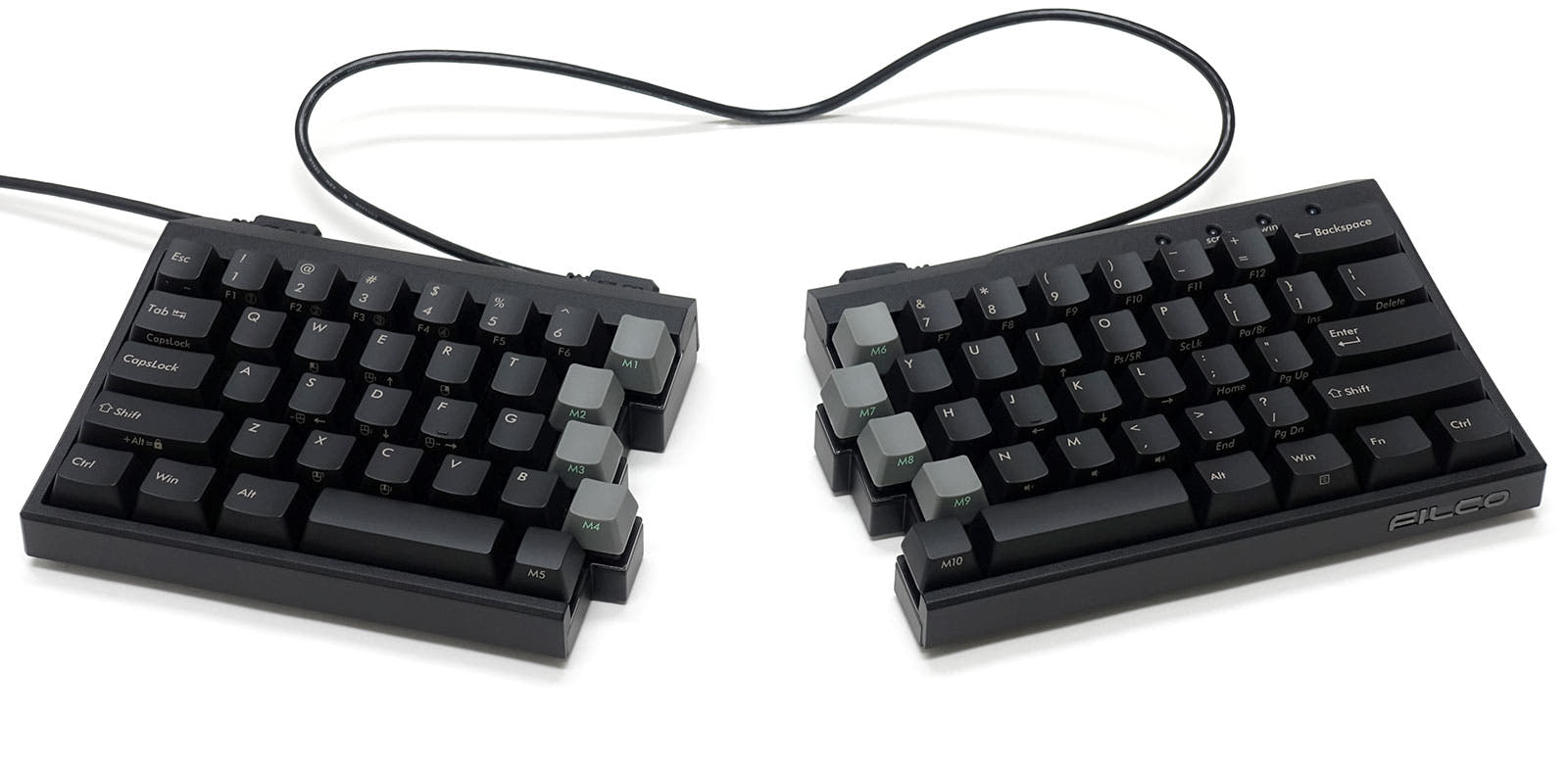

Which one should you get?
Get the
Filco Majestouch Xacro M10SP
Sound dampening
- 10 dedicated macro keys, three programmable layers, and up to eight software profiles.
- Sound-absorbing silicone pad between the plate and PCB.
- Aluminum plate and USB pass-through.
- Switches are soldered. Swapping them means soldering.
- North-facing LEDs. Cherry-profile keycaps can hit the switch housing.
Get the
Mistel Barocco Split
- 1000 Hz polling rate and full N-key rollover.
- The two halves can be joined for a conventional layout or separated, with the right half usable alone.
- Switches are soldered. Swapping them means soldering.
Choose the Filco for its dedicated macro keys, programmable layers, sound-dampening silicone, and USB pass-through. Choose the Mistel if you want its specified 1000 Hz polling and the option to join or separate the keyboard halves. Both require soldering for switch replacement.
The differences that matter
Skip the 40-row spec sheet. These are the specs that change how each board feels, sounds, and fits your desk.
Filco Majestouch Xacro M10SP
Mistel Barocco Split
Case material
ABS
Plastic
Sound dampening
Yes
No
Layout standard
ANSI
ANSI, Colemak, Dvorak
ISO and JIS exist so regional layouts fit
Plate material
Aluminum
Plastic
USB passthrough
Yes
No
- Filco Majestouch Xacro M10SP
- Mistel Barocco Split
- Performance
- 4768
- Build quality
- 4844
- Productivity
- 7048
- Customizability
- 5150
- Portability
- 7166
- Connection: Wired
- Ergonomics: Split
- Switch options: Clicky, Linear, Silent, Tactile
- Mount style: Plate Mount
- Keycaps: PBT
What will you mostly use it for?
The Filco is the more feature-directed option for office work, programming, and macro-heavy creation tasks. The Mistel has the clearer gaming distinction through its listed polling rate and full N-key rollover. Its ability to be joined or separated, including use of the right half alone, makes it the travel-oriented pick. Modding is a draw on the available evidence because both use soldered switches.
Pick the Mistel Barocco Split
- The Mistel lists a 1000 Hz polling rate.
- It also specifies full N-key rollover.
Filco Majestouch Xacro M10SP vs Mistel Barocco Split specs
Every tracked spec, side by side. Rows marked with a dot differ between the boards.
9 of 18 specs differ
Filco Majestouch Xacro M10SP
Mistel Barocco Split
Switch options
Mount style
Sound dampening
Layout standard
Ergonomics
Display
Media keys
Connection
Max polling rate
USB passthrough
USB-C
Case material
Plate material
Keycaps
Backlight
N-key rollover
Mac & Windows
Released
Compare prices
Live prices from the stores we track, cheapest in-stock offer first.
Prices in USD are converted to your currency and can change at any time. KeebFinder may earn a commission when you buy through these links, at no extra cost to you.
Lowest price across stores, Amazon excluded.


- Check on Amazon
Amazon
Check price
Filco Majestouch Xacro M10SP vs Mistel Barocco Split: your questions
The Mistel lists a 1000 Hz polling rate and full N-key rollover, making those features its gaming distinction. The Filco’s listed differentiators are instead focused on macros, layers, and USB pass-through.
Yes. Its vendor description specifies 10 dedicated macro keys in the center of the keyboard, three programmable layers, and up to eight saved software profiles.
Yes. The vendor says its halves can be kept together for a conventional layout or separated for split use. It also says the right half can be used alone.
Neither model is listed as hot-swappable, and both have soldered switches. Replacing switches requires soldering.
The Filco vendor description lists dip-switch layout options for QWERTY, Dvorak, Colemak, and Mac. The metadata also identifies Mac/Windows support.
Yes. Its listed layouts include ANSI, Dvorak, and Colemak, and the vendor description also names QWERTY, Dvorak, and Colemak.
The Filco has USB pass-through, according to its metadata and vendor description. The Mistel listing does not identify a pass-through port.
The Filco has an aluminum plate, while the Mistel has a plastic plate. Both use plate mounting.
The Filco has north-facing LEDs, and its compatibility information warns that Cherry-profile keycaps can hit the switch housing. Check keycap clearance before choosing that profile.
The Filco is listed with sound dampening, and its vendor describes a sound-absorbing silicone pad between the plate and PCB. The Mistel listing does not identify a sound-dampening layer.
The product metadata identifies the Mistel as wired only, while its vendor description lists a Mini USB keyboard-side connection and USB-A device-side connection. The Filco is listed with USB-C.


Still torn?
Answer a few quick questions and the keyboard finder ranks 2,000+ boards by how you will actually use yours.