Keychron Lemokey P1 vs Yunzii AL6575% Layout vs 65% Portability
Choose the Keychron P1 for its 75% layout with function keys and higher polling rate, or the Yunzii AL65 for extreme portability and a massive battery.
KeebFinder may earn a commission when you buy through these links, at no extra cost to you.

5.0 (10)5.0 · 10 reviews
from$104at Keychron

No reviews
from$69at Yunzii
90-day lowLowest price in 90 days
Which one should you get?
Get the
Keychron Lemokey P1
75% Layout
Build quality in the top 5% of 75% boards under $150.
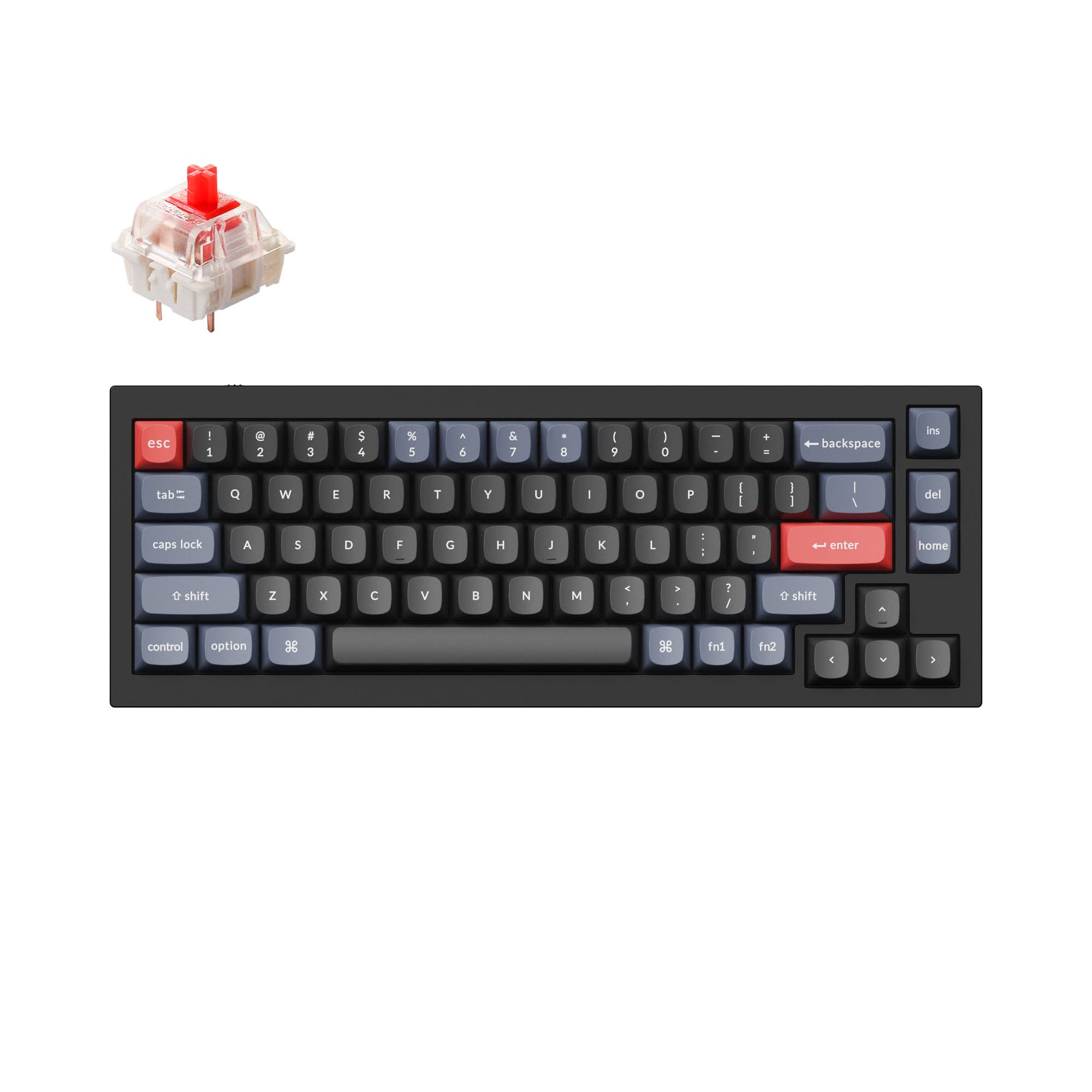
- 75% layout retains function row and navigation keys for productivity.
- Features a programmable aluminum rotary encoder (knob) for media or macro control.
- Available in multiple layout standards including ANSI, ISO, and several European ISO variants.
- South-facing LEDs. Shine-through legends stay dark, and some sculpted keycaps can clip the LED.
- No numpad.
Get the
Yunzii AL65
65% Portability
Build quality in the top 10% of 65% boards under $100.
- Extremely portable 65% layout with a compact footprint.
- Large 8000mAh battery capacity for extended wireless use.
- Lighter weight (1061g) than the Keychron P1.
- South-facing LEDs. Shine-through legends stay dark, and some sculpted keycaps can clip the LED.
- No ISO layout. ISO-DE, UK, and other ISO variants are not offered.
- 65% layout. No function row and no numpad.
Your primary need dictates the choice. If your work or play relies on a function row, navigation keys, and a knob for shortcuts, the Keychron P1 is the more capable and versatile tool. If your priority is a keyboard that is easy to carry, lasts a long time on a charge, and you are comfortable with a more minimalist 65% layout, the Yunzii AL65 is the better fit. Consider the P1 for a primary desk setup and the AL65 as a mobile companion.
The differences that matter
Skip the 40-row spec sheet. These are the specs that change how each board feels, sounds, and fits your desk.
Keychron Lemokey P1
Yunzii AL65
Layout size
75%
65%
Battery
4,000 mAh
8,000 mAh
A larger battery means fewer cables during the day
Switch options
Clicky, Linear, Tactile
Linear
Weight
1,650 g
1,061 g
Heavier boards stay planted and lighter ones travel
Layout standard
ANSI, ISO, ISO-DE, ISO-ES, ISO-FR, ISO-Nordic, ISO-SW, ISO-UK
ANSI
ISO and JIS exist so regional layouts fit
- Keychron Lemokey P1
- Yunzii AL65
- Performance
- 8180
- Build quality
- 8886
- Productivity
- 9790
- Customizability
- 9694
- Portability
- 8194
- Connection: Bluetooth, 2.4 GHz, Wired
- Hot-swappable
- Case material: Aluminum
- Mount style: Gasket Mount
- Knob
- QMK
What will you mostly use it for?
The Keychron P1 is the more versatile choice for stationary use cases like gaming, office work, programming, and content creation, thanks to its larger layout and programmable knob. Its availability in barebones kits also appeals to modders. The Yunzii AL65 dominates for travel due to its smaller 65% size, lighter weight, and much larger battery, making it the clear pick for mobility.
Pick the Keychron Lemokey P1
- The Keychron P1 has a specified 1000 Hz polling rate for its 2.4 GHz and wired modes, which the Yunzii AL65's description does not mention.
- The P1's 75% layout retains arrow keys and some navigation keys, which are useful in many games.
- The P1's vendor page explicitly markets it for gaming with low-latency performance.
Keychron Lemokey P1 vs Yunzii AL65 specs
Every tracked spec, side by side. Rows marked with a dot differ between the boards.
8 of 26 specs differ
Keychron Lemokey P1
Yunzii AL65
Switch options
Hot-swappable
Mount style
Sound dampening
Screw-in stabilizers
Layout size
Layout standard
Ergonomics
Knob
Display
Connection
Max polling rate
Battery
USB-C
Case material
Plate material
Keycaps
Weight
Dimensions
Typing angle
Backlight
QMK
VIA
N-key rollover
Mac & Windows
Released
ISO layouts by store
Which stores sell ISO-DE, UK, and the other regional layouts.
Keychron Lemokey P1
Keychron
ISO-DE, ISO-UK, ISO-Nordic, ISO-SW
In stockShips to you
Keychron (DE)
ISO
In stockDoes not ship to you
Keychron (DE)
ISO-DE, ISO-UK, ISO-Nordic, ISO-SW
In stockDoes not ship to you
Yunzii AL65
No ISO layout at the stores we track.
Compare prices
Live prices from the stores we track, cheapest in-stock offer first.
Prices in USD are converted to your currency and can change at any time. KeebFinder may earn a commission when you buy through these links, at no extra cost to you.
Lowest price across stores, Amazon excluded.




Keychron Lemokey P1 vs Yunzii AL65: your questions
The Yunzii AL65 has a larger 8000mAh battery, which is double the capacity of the Keychron P1's 4000mAh battery. While actual runtime depends on usage like RGB brightness, the AL65's larger capacity suggests it will last significantly longer between charges.
No. The Keychron P1 features a programmable aluminum rotary encoder (knob). The Yunzii AL65's specifications and vendor description do not mention a knob, so it lacks this physical control element.
Yes. Both the Keychron P1 and Yunzii AL65 list Mac and Windows support in their extra features. The Keychron P1's vendor page also notes it includes complimentary keycaps for both operating systems.
The Keychron P1 has specifications that are more gaming-oriented. It explicitly lists a 1000 Hz polling rate for its wireless and wired modes, which is a common spec for low-latency gaming. The Yunzii AL65's description does not specify its polling rate.
Yes, both keyboards use standard Cherry profile PBT keycaps, making them compatible with a wide range of aftermarket keycap sets. The Keychron P1 uses double-shot PBT keycaps, while the Yunzii AL65 also uses double-shot PBT Cherry profile keycaps.
Yes, both keyboards feature hot-swappable PCBs. This allows you to change the mechanical switches without soldering. The Keychron P1 is compatible with most 3-pin and 5-pin MX-style switches, and the Yunzii AL65 also supports 3-pin and 5-pin switches.
The Keychron P1 is a 75% layout, which includes a dedicated function row (F1-F12) and a column of navigation keys like Insert and Delete. The Yunzii AL65 is a 65% layout, which omits the function row and further condenses the navigation cluster, relying more on function layers.
Yes. Both the Keychron P1 and Yunzii AL65 list QMK Support and VIA Support in their extra features. This allows for deep customization of keymaps, macros, and lighting through these open-source platforms.
The Keychron P1 is significantly heavier. It weighs 1650 grams, while the Yunzii AL65 weighs 1061 grams. This makes the AL65 over 500 grams lighter and more portable.
Yes. The Keychron P1's metadata lists support for multiple layout standards including ISO, ISO-DE (German), ISO-ES (Spanish), ISO-FR (French), ISO-Nordic, ISO-SW (Swiss), and ISO-UK. The Yunzii AL65 is listed only with ANSI layout.
The Keychron P1 vendor description mentions a combination of IXPE, PET, and absorbing foam. The Yunzii AL65 vendor description states it uses five layers of sound-dampening foams. Both aim to reduce typing noise and vibration.
Yes. According to its listed features, the Keychron P1 is available as a 'Diy Kit/Barebones' option. The vendor description confirms a barebone version is available that does not include keycaps and switches.
Not sold on either?




Still torn?
Answer a few quick questions and the keyboard finder ranks 2,000+ boards by how you will actually use yours.