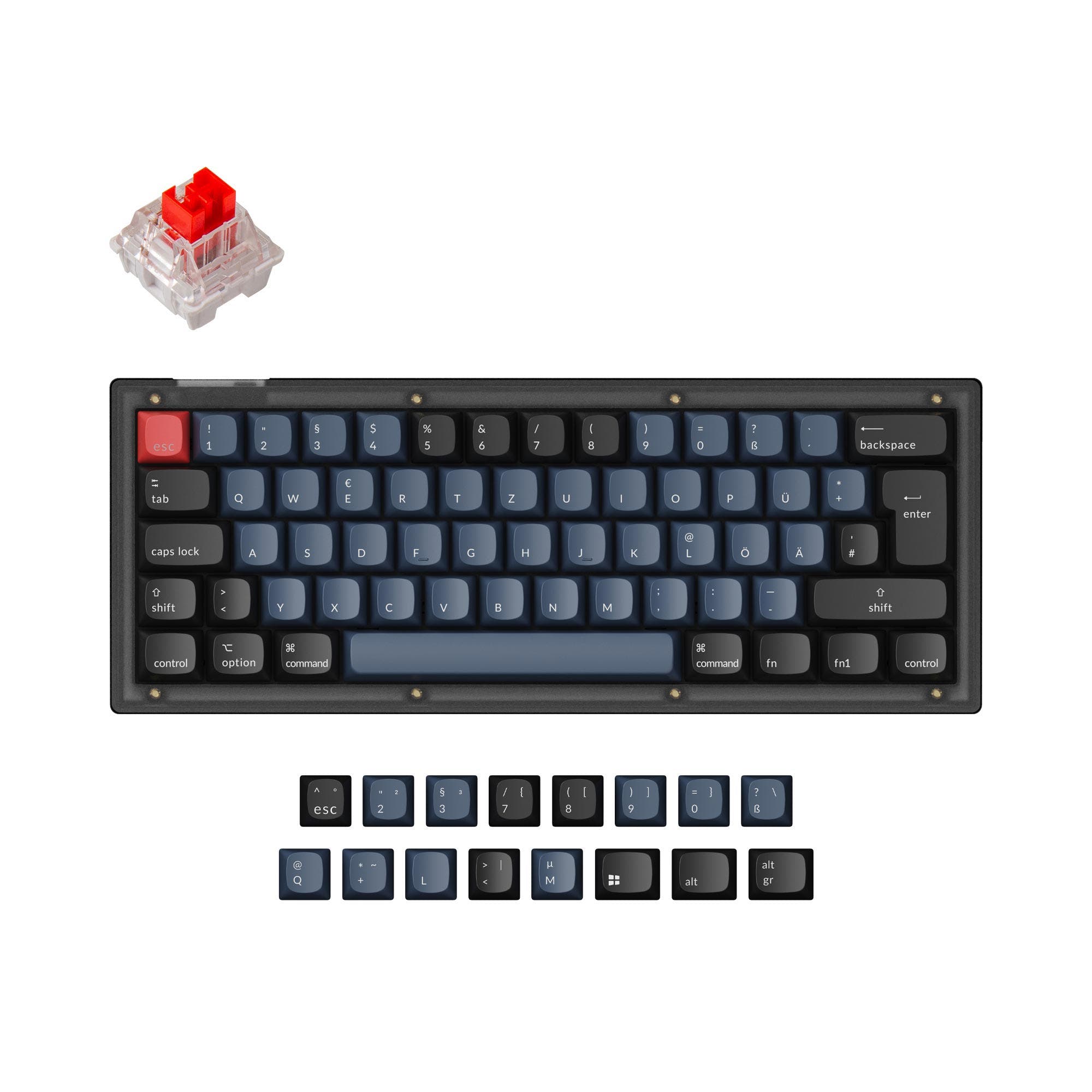
ATTACK SHARK X68 HE vs Qwertykeys Neo60 Core
Rapid Trigger or Wireless
Get the X68 HE for Hall Effect switches, Rapid Trigger, and 8000 Hz polling; choose the Neo60 Core for wireless connectivity, VIA support, and multiple plate options.
Prices checked Nov 24, 2026. KeebFinder may earn a commission when you buy through these links, at no extra cost to you.
Hall effect


Which one should you get?
Get the
ATTACK SHARK X68 HE
Hall effect
Build quality in the bottom 40% of 65% boards under $100.
If you want
- Hall Effect magnetic switches with Rapid Trigger and adjustable actuation.
- 8000 Hz polling rate, with vendor-stated 0.125 ms latency.
- South-facing RGB lighting and PBT double-shot keycaps.
Rules this board out
- Magnetic switches only. Standard MX switches will not fit.
- South-facing LEDs. Shine-through legends stay dark, and some sculpted keycaps can clip the LED.
- No ISO layout. ISO-DE, UK, and other ISO variants are not offered.
- 65% layout. No function row and no numpad.
Get the
Qwertykeys Neo60 Core
Build quality in the top 15% of 60% boards under $50.
If you want
- Bluetooth and 2.4 GHz wireless connectivity, alongside wired USB-C.
- VIA support for keyboard configuration.
- Multiple plate options, including Carbon Fiber, Aluminum, FR4, POM, and PP.
Rules this board out
- Compact layout only. No function row, dedicated arrow keys, or numpad.
Bottom line
Choose the ATTACK SHARK X68 HE for Hall Effect switches, Rapid Trigger, and its 8000 Hz polling rate. Choose the Qwertykeys Neo60 Core if you want wireless connectivity, VIA support, ISO availability, or a choice of plate materials. Both use compact layouts, so check the missing keys against your needs before buying.
The differences that matter
- Layout size
65%
60%
- Hall effect (magnetic)
Yes
No
Adjustable actuation helps in games and not in normal typing - Rapid trigger
Yes
No
Faster resets help in games and not in normal typing - Connection
Wired
Bluetooth, 2.4 GHz, Wired
Wireless for several devices and wired for lower latency - Weight
950 g
1,500 g
Heavier boards stay planted and lighter ones travel
KeebFinder scores
How we score- ATTACK SHARK X68 HE
- Qwertykeys Neo60 Core
- Performance
- 9258
- Build quality
- 5779
- Productivity
- 5960
- Customizability
- 6171
- Portability
- 7186
What they share
- Hot-swappable
- Case material: Aluminum
What will you mostly use it for?
For gaming, pick the ATTACK SHARK X68 HE
- Hall Effect magnetic switches support Rapid Trigger and adjustable actuation.
- The listed 8000 Hz polling rate and vendor-stated 0.125 ms latency suit buyers prioritizing fast input response.
ATTACK SHARK X68 HE vs Qwertykeys Neo60 Core specs
18 of 24 specs differ
 |  | |
| ATTACK SHARK X68 HE$89 | Qwertykeys Neo60 Core$49 | |
|---|---|---|
| Typing & switches | ||
| Switch options (differs) | Clicky, Linear, Magnetic | Not specified |
| Hall effect (magnetic) (differs) | Yes | No |
| Rapid trigger (differs) | Yes | No |
| Hot-swappable | Yes | Yes |
| Mount style (differs) | Not specified | PCB Mount |
| Layout | ||
| Layout size (differs) | 65% | 60% |
| Layout standard (differs) | ANSI | ANSI, ISO |
| Ergonomics | Standard | Standard |
| Display | None | None |
| Connectivity & battery | ||
| Connection (differs) | Wired | Bluetooth, 2.4 GHz, Wired |
| Max polling rate (differs) | 8,000 Hz | Not specified |
| Battery (differs) | Wired only | 2,200 mAh |
| USB-C | Yes | Yes |
| Build & materials | ||
| Case material | Aluminum | Aluminum |
| Plate material (differs) | Not specified | Aluminum, CarbonFiber, FR4, Plastic, POM |
| Keycaps (differs) | PBT | Not specified |
| Weight (differs) | 950 g | 1,500 g |
| Dimensions (differs) | 60 x 150 x 350 mm | 18 x 293 x 109 mm |
| Typing angle (differs) | Not specified | 8° |
| Backlight (differs) | RGB, south-facing | None |
| Firmware & software | ||
| VIA (differs) | No | Yes |
| N-key rollover (differs) | No | Yes |
| Mac & Windows (differs) | Yes | No |
| Extras | ||
| Released | 2025 | 2025 |
Compare prices
Prices in USD are converted to your currency and can change at any time. KeebFinder may earn a commission when you buy through these links, at no extra cost to you.
Lowest price across stores, Amazon excluded.
- Price now
- $49
- Lowest in range
- $49Aug 25
- Highest in range
- $49Aug 25
Price in USD
- Check on Amazon
AmazonGlobal
Check price


- Check on Amazon
AmazonGlobal
Check price - Extra 5% off

ISO layouts by store
ATTACK SHARK X68 HE
No ISO layout at the stores we track.
Qwertykeys Neo60 Core
Listed on the product, not split by store: ISO.