Epomaker Galaxy100 vs Keychron V3Wireless 96% vs Wired TKL
Choose the Epomaker Galaxy100 for wireless flexibility and a full layout, or the Keychron V3 for a more affordable, highly customizable wired TKL.
KeebFinder may earn a commission when you buy through these links, at no extra cost to you.

4.6 (68)4.6 · 68 reviews
from$87at Epomaker
90-day lowLowest price in 90 days
4.7 (18)4.7 · 18 reviews
from$54at Keychron
Which one should you get?
Get the
Epomaker Galaxy100
Wireless 96%
Build quality in the top 15% of 96% boards under $100.
- Triple-mode connectivity with Bluetooth 5.0, 2.4GHz, and wired options.
- Aluminum alloy case construction with a gasket-mount design for a tuned typing feel.
- Large 8000mAh battery for extended wireless use.
- South-facing LEDs. Shine-through legends stay dark, and some sculpted keycaps can clip the LED.
- No ISO layout. ISO-DE, UK, and other ISO variants are not offered.
- Compact full-size layout. The numpad is present, the gaps of a full-size board are not.
Get the
Keychron V3
Wired TKL
Build quality in the top 5% of 80% boards under $100.
- Available as a fully assembled keyboard or a barebones kit for customization.
- Includes screw-in PCB stabilizers for a more stable and moddable typing experience.
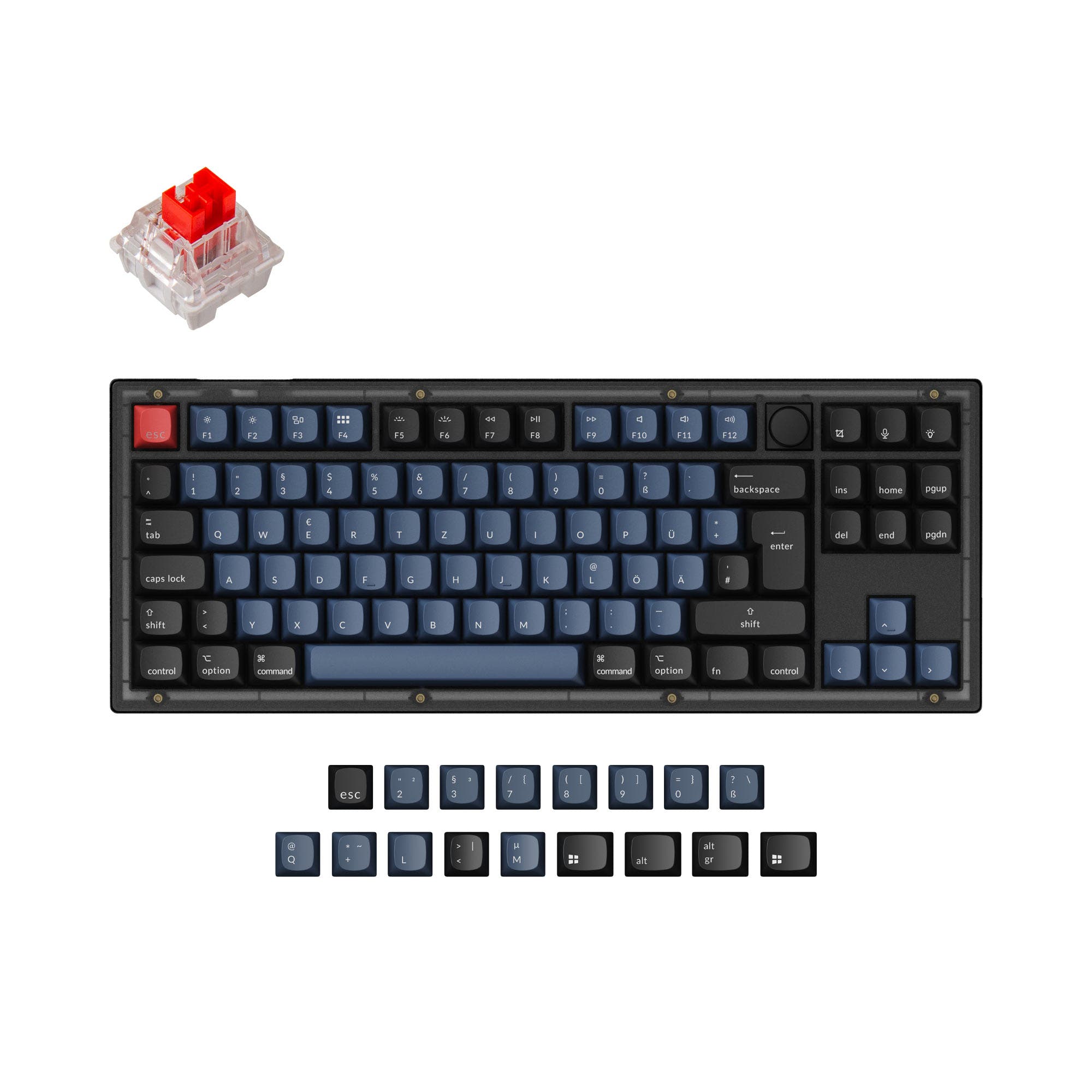
- Supports an extensive range of layout standards including ANSI, ISO, JIS, and several European ISO variants.
- South-facing LEDs. Shine-through legends stay dark, and some sculpted keycaps can clip the LED.
- No numpad.
Your primary need dictates the choice. If wireless operation, a numpad, and an aluminum build are non-negotiable for your multi-device or data-heavy workflow, the Epomaker Galaxy100 is the clear pick. If you prioritize a lower cost, a proven platform for modding with screw-in stabilizers, and can work within a wired, TKL footprint, the Keychron V3 offers exceptional customization potential.
The differences that matter
Skip the 40-row spec sheet. These are the specs that change how each board feels, sounds, and fits your desk.
Epomaker Galaxy100
Keychron V3
Layout size
96%
80%
Connection
Bluetooth, 2.4 GHz, Wired
Wired
Wireless for several devices and wired for lower latency
Max polling rate
1,000 Hz
8,000 Hz
Higher polling helps competitive FPS and does nothing for typing
Case material
Aluminum
ABS, Plastic
Switch options
Clicky, Linear
Clicky, Linear, Tactile
- Epomaker Galaxy100
- Keychron V3
- Performance
- 8391
- Build quality
- 8489
- Productivity
- 9398
- Customizability
- 8898
- Portability
- 6258
- Hot-swappable
- Knob
- QMK
- VIA
- Sound dampening
What will you mostly use it for?
The Epomaker Galaxy100 wins for office use, gaming, and content creation, largely due to its wireless modes, numpad, and metal knob. The Keychron V3 is the better choice for travel and modding, thanks to its lighter weight, barebones availability, and screw-in stabilizers. For programming, both are equally capable with their extensive QMK/VIA support, leaving the choice to layout preference.
Pick the Epomaker Galaxy100
- The Galaxy100 offers a 1000Hz polling rate over both USB and 2.4GHz wireless, with a listed 2.81ms latency in wired mode.
- Its 96% layout includes a numpad for macros or in-game commands, which the TKL V3 lacks.
- The aluminum case provides a stable, heavy base during intense use.
What owners say
Ratings and quotes collected from verified store reviews, including the critical ones.
Epomaker Galaxy100
68 owner reviews
“Amazing keyboard, via support could be better, but it works! i love the knob, its so nice. this has to be the worst financial decision ive ever made and i dont regret it”
“The keyboard has been great but when I received it a couple keys were broken. I had to glue the inside connector back together as it had broken apart. Otherwise the keyboard has functions very well.”
Keychron V3
18 owner reviews
“Mainly bought this keyboard for the russian layout, despite this I prefer it over my steelseries apex pro, its nice feel and sounds nice”
“I bought this keyboard in March 2023 and genuinely liked it at first. It's solid, heavy, well-built, sounds great. Keychron clearly knows what they're doing in terms of design and firmware. The problem is the switches. After about a year and a half of normal…”
Epomaker Galaxy100 vs Keychron V3 specs
Every tracked spec, side by side. Rows marked with a dot differ between the boards.
15 of 27 specs differ
Epomaker Galaxy100
Keychron V3
Switch options
Hot-swappable
Mount style
Sound dampening
Screw-in stabilizers
Layout size
Layout standard
Ergonomics
Knob
Display
Media keys
Connection
Max polling rate
Battery
USB-C
Case material
Plate material
Keycaps
Weight
Dimensions
Typing angle
Backlight
QMK
VIA
N-key rollover
Mac & Windows
Released
ISO layouts by store
Which stores sell ISO-DE, UK, and the other regional layouts.
Epomaker Galaxy100
No ISO layout at the stores we track.
Keychron V3
Keychron
ISO-DE, ISO-UK, ISO-FR, ISO-ES, ISO-SW
In stockShips to you
Keychron (DE)
ISO-DE, ISO-ES
In stockDoes not ship to you
Keychron (DE)
ISO-DE, ISO-UK, ISO-FR, ISO-ES, ISO-SW
Out of stockDoes not ship to you
Compare prices
Live prices from the stores we track, cheapest in-stock offer first.
Prices in USD are converted to your currency and can change at any time. KeebFinder may earn a commission when you buy through these links, at no extra cost to you.
Lowest price across stores, Amazon excluded.




Epomaker Galaxy100 vs Keychron V3: your questions
Yes, the Epomaker Galaxy100 is listed as compatible with Mac, Windows, and Android systems. The manufacturer's specifications explicitly state Mac/WIN/Android compatibility.
No, the Keychron V3 is a wired-only keyboard. Its connectivity is listed as Type-C wired, and the vendor description does not mention any wireless capabilities.
The Epomaker Galaxy100 may have an advantage for quiet environments. Its vendor description emphasizes sound-dampening with five layers of materials like Poron and IXPE foam, and it comes with pre-lubed linear switches designed for a softer sound.
Yes, both the Epomaker Galaxy100 and the Keychron V3 feature hot-swappable PCBs that support both 3-pin and 5-pin mechanical switches, allowing for easy switch changes without soldering.
The Galaxy100 uses a gasket mount, where the plate is suspended by rubber or silicone gaskets for a softer, more cushioned typing feel. The V3 uses a tray mount, where the plate is screwed directly into the case for a more rigid and direct feedback.
The Keychron V3 is available in versions with and without a knob. The vendor listing shows separate options for 'Fully Assembled Knob' and 'Barebone Knob' configurations.
The Epomaker Galaxy100 has an 8000mAh battery. While the exact runtime is not specified, the manufacturer describes it as 'long-lasting' and capable of supporting continuous wireless gaming sessions without interruption.
Both keyboards offer extensive software customization via open-source QMK firmware and VIA software, allowing for key remapping, macros, and layer editing. The Keychron V3 also mentions compatibility with the Keychron Launcher web app.
No, both keyboards feature south-facing RGB LEDs, but the keycaps are not shine-through. The Galaxy100 uses dye-subbed PBT keycaps, and the V3 uses double-shot OSA PBT keycaps, both designed to resist shine while allowing underglow lighting effects.
The Epomaker Galaxy100 comes with plate-mount stabilizers. The manufacturer's technical specifications note that the board is 'Not compatible with Screw-in Stabilizer,' limiting your upgrade options to other plate-mount stabilizers.
The fully assembled Keychron V3 comes with Keychron K Pro switches. The vendor listing shows options for Keychron K Pro Red (linear), Blue (clicky), and Brown (tactile) switches, which are described as factory pre-lubed for smoothness.
Both support a 1000Hz polling rate in their primary wired mode. The Keychron V3 vendor description also lists an 8000 Hz polling rate. The Galaxy100 specifies a 1000Hz rate for USB and 2.4GHz, and 125Hz for Bluetooth.
Not sold on either?


Still torn?
Answer a few quick questions and the keyboard finder ranks 2,000+ boards by how you will actually use yours.