Nuphy Halo75 V2 vs Air75 V3Full-Size Feel vs Ultra-Portable
Choose the Halo75 V2 for deep customization and a premium typing experience, or the Air75 V3 for maximum portability and a sleek, low-profile design.
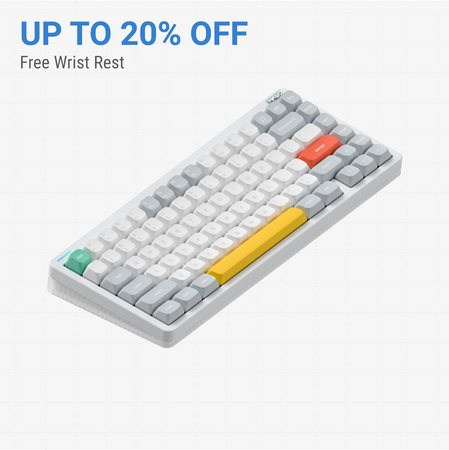

Which one should you get?
Get the
Nuphy Halo75 V2
Full-Size Feel
- Extensive firmware support with QMK and VIA for advanced key remapping.
- Comprehensive 6-piece sound dampening stack including plate foam and PCB foam.
- Offers both NuPhy Herb series and Cherry Silent Red Clear-Top switch options.
- Much thicker and heavier (33mm, 1020g) than the Air75 V3, reducing portability.
- Lacks a programmable knob, which is present on the Air75 V3.
- Uses plate-mounted stabilizers instead of screw-in stabilizers.
Get the
Nuphy Air75 V3
Ultra-Portable
- Extremely thin and portable low-profile design at 13mm thick and 750g weight.
- Includes a programmable knob for media or application control.
- Features a 3-stage adjustable kickstand for ergonomic typing angles.
- Lacks support for QMK/VIA firmware, using proprietary NuPhy IO 2.0 software instead.
- Fewer switch type options (Clicky, Linear) compared to the Halo75 V2.
- No vendor description mentions of advanced sound dampening layers like the Halo75's stack.
Your decision rests on form factor and customization depth. For a stationary, immersive typing experience with unparalleled firmware and acoustic customization, the Halo75 V2 is the superior tool. If your workflow involves moving between a laptop, iPad, or Mac and you value a sleek, low-profile design with convenient features like a knob, the Air75 V3 is the more practical and portable companion.
The differences that matter
Skip the 40-row spec sheet. These are the specs that change how each board feels, sounds, and fits your desk.
Nuphy Halo75 V2
Nuphy Air75 V3
Low profile
No
Yes
Case material
ABS, Aluminum
ABS, Aluminum, Plastic, Polycarbonate
Switch options
Mechanical
Clicky, Linear, Low-profile 3.0, Mechanical, Tactile
Knob
No
Yes
Weight
1,020 g
750 g
- Nuphy Halo75 V2
- Nuphy Air75 V3
- Performance
- 8082
- Build quality
- 8188
- Productivity
- 8897
- Customizability
- 8998
- Portability
- 8181
- Layout size: 75%
- Connection: Bluetooth, 2.4 GHz, Wired
- Hot-swappable
- Battery: 4,000 mAh
- Max polling rate: 1,000 Hz
- Mount style: Gasket Mount
What will you mostly use it for?
The Halo75 V2 is the clear choice for users who prioritize typing feel, sound, and deep software customization, winning in Gaming, Programming, and Modding. The Air75 V3 excels in portability and seamless integration with Apple ecosystems, making it superior for Office use, Travel, and Content Creation, especially with its included knob. Your primary use case dictates the winner.
Pick the Nuphy Halo75 V2
- Both offer a 1000Hz polling rate for low latency.
- Halo75 V2's vendor description highlights a 'pro-gaming level wireless performance' optimization.
- The Halo75 V2 offers silent switch options like Cherry Silent Red Clear-Top for quieter gaming sessions.
Nuphy Halo75 V2 vs Air75 V3 specs
Every tracked spec, side by side. Rows marked with a dot differ between the boards.
10 of 28 specs differ
Nuphy Halo75 V2
Nuphy Air75 V3
Switch options
Hot-swappable
Mount style
Low profile
Sound dampening
Screw-in stabilizers
Layout size
Layout standard
Ergonomics
Knob
Display
Media keys
Connection
Max polling rate
Battery
USB-C
Case material
Plate material
Keycaps
Weight
Dimensions
Typing angle
Backlight
QMK
VIA
N-key rollover
Mac & Windows
Released
Compare prices
Live prices from the stores we track, cheapest in-stock offer first.
Lowest price across stores, Amazon excluded.




Prices in USD are converted to your currency and can change at any time. KeebFinder may earn a commission when you buy through these links, at no extra cost to you.
Nuphy Halo75 V2 vs Air75 V3: your questions
The Air75 V3 is explicitly marketed for Mac and iPad users, with a vendor description stating it 'belongs' on Apple devices. It includes a dedicated OS switch and Mac-specific keycaps. The Halo75 V2 is also compatible with macOS but is not specifically tailored for it.
Yes, but the methods differ. The Halo75 V2 uses the open-source QMK and VIA firmware for deep, system-level remapping. The Air75 V3 uses NuPhy's proprietary web-based NuPhy IO 2.0 software for customization, including macros and lighting.
The Halo75 V2 has more built-in sound dampening, including a 6-piece stack with foam and silicone. It also offers silent switch options like the Cherry Silent Red Clear-Top. The Air75 V3's vendor description does not detail similar acoustic treatments.
The Air75 V3 has a 1000Hz polling rate, which is suitable for gaming. However, the Halo75 V2's vendor description specifically highlights 'pro-gaming level wireless performance' and optimization for low latency, which may give it a slight edge for competitive gamers.
Yes, both the NuPhy Halo75 V2 and Air75 V3 feature hot-swappable sockets, allowing you to change switches without soldering.
The Halo75 V2 features enhanced 'Halolight 2.0' with a translucent bottom case and eight different light types for more dramatic effects. The Air75 V3 has per-key RGB and a rhythm light bar that can indicate typing speed.
Both have a 4000mAh battery. The Halo75 V2's lab tests show up to 307 hours with lights off. The Air75 V3 vendor description claims 1200 hours with RGB off, a significant claimed improvement over previous models.
Yes, the Air75 V3's vendor description states the knob can be programmed for functions like 'volume up/down' through the NuPhy IO 2.0 software. The Halo75 V2 does not have a knob.
The Halo75 V2 uses a high-profile mSA keycap set. The Air75 V3 uses low-profile keycaps to match its switch and case design. Both keycaps are made from PBT material.
The Halo75 V2 is significantly more modder-friendly. It supports QMK/VIA, has a detailed sound dampening stack to modify, and a PCB gasket mount. The Air75 V3 uses proprietary software and its low-profile design may limit aftermarket part compatibility.
The Halo75 V2 has a wide variety of matching Twotone wrist rests available for purchase, including acrylic and hardwood options. The vendor description for the Air75 V3 does not mention specific wrist rests, but it includes a 3-way kickstand for angle adjustment.
Not sold on either?


Still torn?
Answer a few quick questions and the keyboard finder ranks 2,000+ boards by how you will actually use yours.