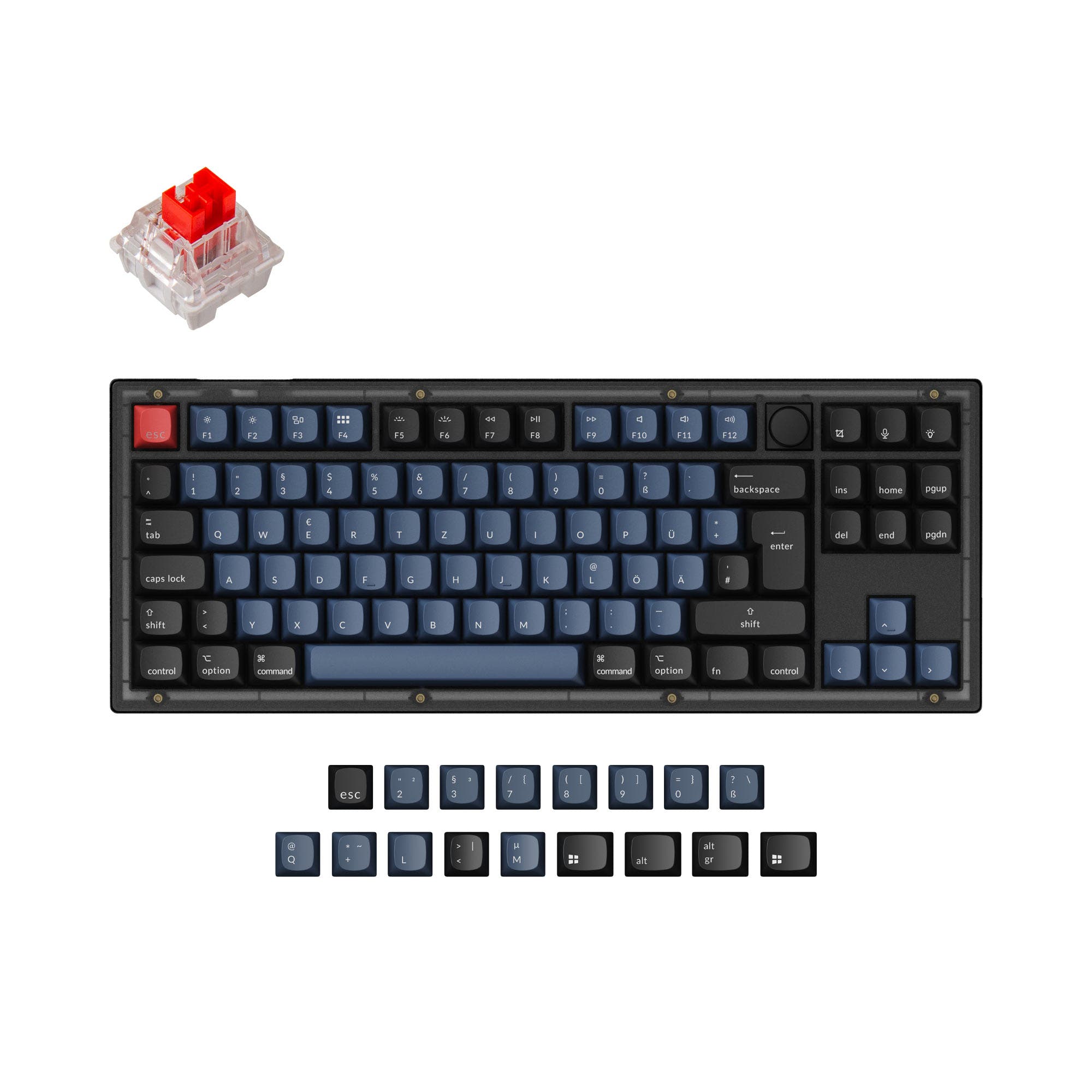
KBDFans Chamber TKL vs KO Onibi
TKL or 60%
Get the Chamber TKL for its TKL layout, hot-swap option and choice of mount and plate materials; choose the Ko Onibi for a more compact 60% layout.
Prices checked Nov 17, 2026. KeebFinder may earn a commission when you buy through these links, at no extra cost to you.
Hot-swappable


Which one should you get?
Get the
KBDFans Chamber TKL
Hot-swappable
Build quality in the top 5% of 80% boards under $100.
If you want
- Hot-swap PCB option, alongside a solder PCB option.
- ANSI and ISO layout options, with TKL key placement.
- Top-mount design and selectable aluminum, polycarbonate, FR4 or carbon plates.
Rules this board out
- No numpad.
Get the
KBDFans KO Onibi
If you want
- 60% layout for buyers who want a compact keyboard.
Rules this board out
- Switches are soldered. Swapping them means soldering.
- No ISO layout. ISO-DE, UK, and other ISO variants are not offered.
- Compact layout only. No function row, dedicated arrow keys, or numpad.
Bottom line
Choose the KBDFans Chamber TKL for its TKL layout, hot-swap option, ANSI and ISO choices, and configurable mount and plate materials. Choose the KBDFans Ko Onibi if a 60% layout is the priority and you are comfortable with soldered switches and ANSI-only key placement.
The differences that matter
- Layout size
80%
60%
- Hot-swappable
Yes
No
Switch changes without soldering - Ergonomics
Split Backspace
Standard
- Mount style
Top Mount, Tray Mount
Plate Mount
- QMK
Yes
No
The deep option when you want to remap every key
KeebFinder scores
How we score- KBDFans Chamber TKL
- KBDFans KO Onibi
- Performance
- 5843
- Build quality
- 9063
- Productivity
- 7941
- Customizability
- 9353
- Portability
- 5563
What they share
- Max polling rate: 1,000 Hz
- Display: LED
What will you mostly use it for?
For gaming, pick the KBDFans Chamber TKL
- Both list a 1000 Hz polling rate, so that spec does not separate them.
- The Chamber TKL offers hot-swap switches and dedicated function-row and arrow-key positions in its TKL layout.
KBDFans Chamber TKL vs KO Onibi specs
13 of 17 specs differ
 |  | |
| KBDFans Chamber TKL$9 | KBDFans KO Onibi | |
|---|---|---|
| Typing & switches | ||
| Hot-swappable (differs) | Yes | No |
| Mount style (differs) | Top Mount, Tray Mount | Plate Mount |
| Layout | ||
| Layout size (differs) | 80% | 60% |
| Layout standard (differs) | ANSI, ISO | ANSI |
| Ergonomics (differs) | Split Backspace | Standard |
| Display | LED | LED |
| Connectivity & battery | ||
| Connection (differs) | Wired | Not specified |
| Max polling rate | 1,000 Hz | 1,000 Hz |
| Build & materials | ||
| Case material (differs) | Aluminum, Polycarbonate | Not specified |
| Plate material (differs) | Aluminum, CarbonFiber, FR4, Polycarbonate | Not specified |
| Dimensions (differs) | 36 x 359 x 140 mm | Not specified |
| Typing angle (differs) | 7° | Not specified |
| Backlight | None | None |
| Firmware & software | ||
| QMK (differs) | Yes | No |
| VIA (differs) | Yes | No |
| VIAL (differs) | Yes | No |
| Extras | ||
| Released | 2026 | 2026 |
Compare prices
Prices in USD are converted to your currency and can change at any time. KeebFinder may earn a commission when you buy through these links, at no extra cost to you.
- Check on Amazon
AmazonGlobal
Check price - Extra 5% off
- Go to KBDfans
KBDfansCN
Out of stock



- Check on Amazon
AmazonGlobal
Check price - Go to KBDfans
KBDfansCN
Out of stock - Go to MonacoKeys
MonacoKeysDE
Out of stockExtra 5% offExtra 5% off
ISO layouts by store
KBDFans Chamber TKL
Listed on the product, not split by store: ISO.
KBDFans KO Onibi
No ISO layout at the stores we track.