Keychron K1 Max vs K3 HE80% Mechanical or 75% Hall Effect
Choose the K3 HE for Hall Effect magnetic switches with Rapid Trigger and adjustable actuation, or the K1 Max for a wider 80% TKL layout with a larger battery.
KeebFinder may earn a commission when you buy through these links, at no extra cost to you.

4.6 (10)4.6 · 10 reviews
from$89at Keychron
90-day lowLowest price in 90 days

5.0 (6)5.0 · 6 reviews
from$119at Keychron
Which one should you get?
Get the
Keychron K1 Max
Battery
Build quality in the top 10% of 80% boards under $100.
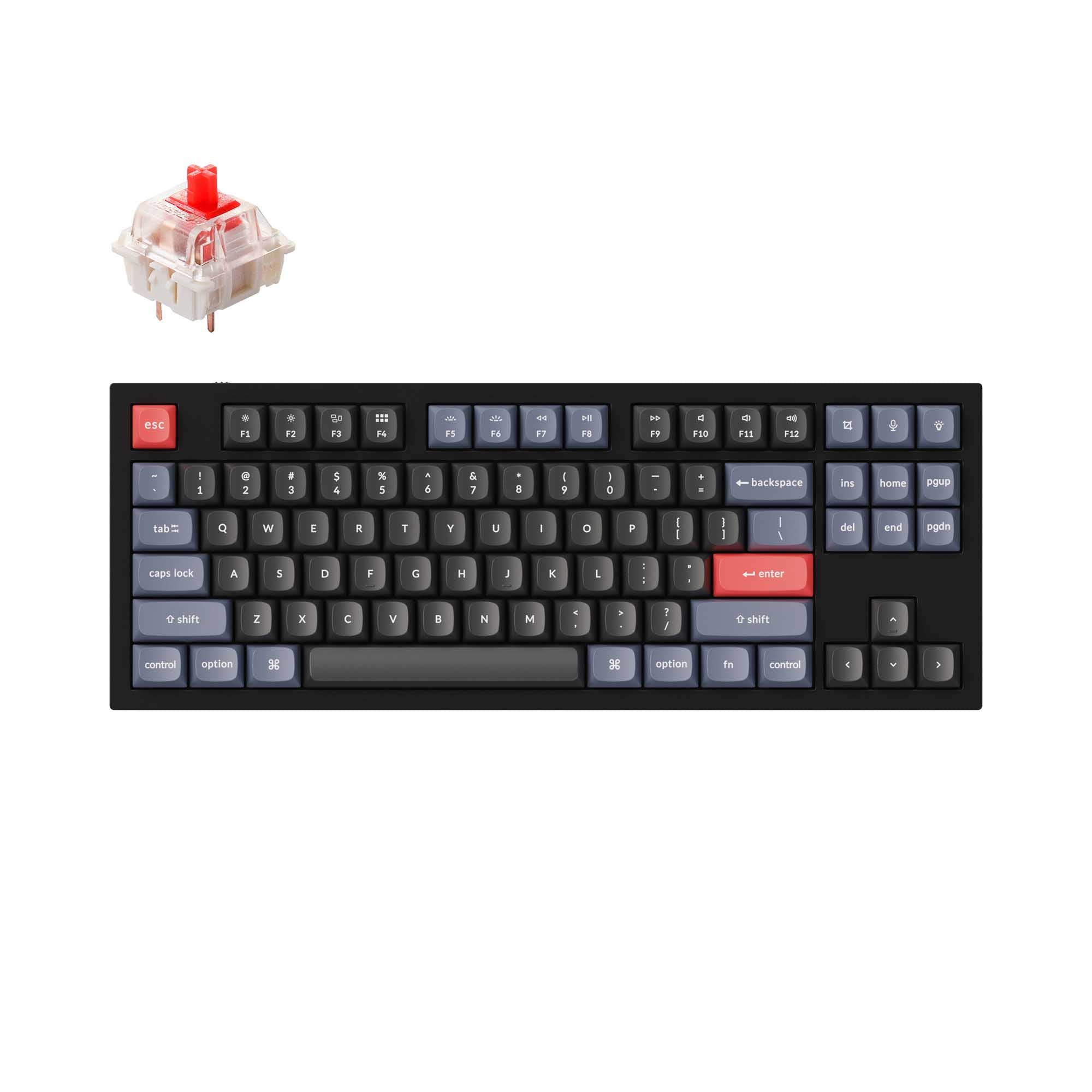
- 80% TKL layout provides more dedicated keys than the K3 HE’s 75% layout.
- 4000mAh battery is larger than the K3 HE’s 2600mAh, according to the specs.
- Low-profile Gateron mechanical switches come in linear and tactile options, with hot-swap support on the RGB hot-swappable version.
- Low-profile switches and keycaps only. Standard MX keycaps will not fit.
- North-facing LEDs. Cherry-profile keycaps can hit the switch housing.
- Missing ISO-FR, ISO-ES. The other board is sold in those layouts.
- No numpad.
Get the
Keychron K3 HE
Hall effect
Build quality in the top 10% of 75% boards under $150.
- Hall Effect magnetic switches with Rapid Trigger and adjustable actuation from 0.2 to 2.9 mm at 0.1 mm sensitivity.
- Analog mode plus four-in-one dynamic keystrokes assign multiple commands to one key by press depth.
- Aluminum and wood frame with an aluminum plate, plus listed foam, silicone pad, and PET film layers.
- Magnetic switches only. Standard MX switches will not fit.
- Low-profile switches and keycaps only. Standard MX keycaps will not fit.
- North-facing LEDs. Cherry-profile keycaps can hit the switch housing.
- Missing ISO-UK, ISO-Nordic. The other board is sold in those layouts.
- No numpad.
Pick the K3 HE if Hall Effect magnetic switches, Rapid Trigger, adjustable actuation, and a compact 75% body are the priority. Choose the K1 Max if you want an 80% TKL layout with more keys, 12 multimedia keys, and a larger 4000mAh battery for office or content creation work. Both share QMK, Keychron Launcher, and triple connectivity, so switch technology and layout size are the real deciding factors.
The differences that matter
Skip the 40-row spec sheet. These are the specs that change how each board feels, sounds, and fits your desk.
Keychron K1 Max
Keychron K3 HE
Layout size
80%
75%
Hall effect (magnetic)
No
Yes
Adjustable actuation helps in games and not in normal typing
Rapid trigger
No
Yes
Faster resets help in games and not in normal typing
Battery
4,000 mAh
2,600 mAh
A larger battery means fewer cables during the day
Case material
ABS, Aluminum, Plastic
ABS, Aluminum, Wood
- Keychron K1 Max
- Keychron K3 HE
- Performance
- 8292
- Build quality
- 8186
- Productivity
- 9089
- Customizability
- 8989
- Portability
- 7382
- Connection: Bluetooth, 2.4 GHz, Wired
- Hot-swappable
- Low profile
- Max polling rate: 1,000 Hz
- QMK
- VIA
What will you mostly use it for?
The K3 HE takes gaming, travel, and modding because its Hall Effect magnetic switches, Rapid Trigger, adjustable actuation, compact 75% size, and listed travel pouch fit those uses. The K1 Max wins office and content creation through its wider 80% TKL layout, 12 multimedia keys, and larger 4000mAh battery. Programming is a tie since both run QMK and Keychron Launcher and are hot-swappable, with the choice coming down to layout size and switch type.
Pick the Keychron K3 HE
- Hall Effect magnetic switches with Rapid Trigger and adjustable actuation from 0.2 to 2.9 mm.
- Last Key Priority (LKP) and Snap Click features, enableable in the Keychron Launcher, for faster directional changes.
- Analog mode and four-in-one dynamic keystrokes let one key trigger multiple commands by press depth.
What owners say
Ratings and quotes collected from verified store reviews, including the critical ones.
Keychron K1 Max
10 owner reviews
“My first better keyboard and I am absolutely satisfied. We'll see how it works after a longer time. I just thought of one small thing, I have nowhere to hide the receiver when I leave with just the laptop and I want to leave the keyboard at home. Like you can…”
Keychron K3 HE
6 owner reviews
“I am happy with this keyboard! I needed some time to adjust my typing habits, but so far so good.”
Keychron K1 Max vs K3 HE specs
Every tracked spec, side by side. Rows marked with a dot differ between the boards.
16 of 28 specs differ
Keychron K1 Max
Keychron K3 HE
Switch options
Hall effect (magnetic)
Rapid trigger
Hot-swappable
Mount style
Low profile
Sound dampening
Layout size
Layout standard
Ergonomics
Display
Media keys
Connection
Max polling rate
Battery
USB-C
Case material
Plate material
Keycaps
Weight
Dimensions
Typing angle
Backlight
QMK
VIA
N-key rollover
Mac & Windows
Released
ISO layouts by store
Which stores sell ISO-DE, UK, and the other regional layouts.
Keychron K1 Max
Keychron
ISO-DE, ISO-UK, ISO-Nordic
Out of stockShips to you
Keychron (DE)
ISO-DE, ISO-UK
Out of stockDoes not ship to you
Keychron K3 HE
Keychron
ISO-DE
In stockShips to you
Keychron (DE)
ISO-DE, ISO-FR, ISO-ES
In stockDoes not ship to you
Compare prices
Live prices from the stores we track, cheapest in-stock offer first.
Prices in USD are converted to your currency and can change at any time. KeebFinder may earn a commission when you buy through these links, at no extra cost to you.
Lowest price across stores, Amazon excluded.




Keychron K1 Max vs K3 HE: your questions
The K1 Max uses low-profile Gateron mechanical switches in an 80% TKL layout, while the K3 HE uses Keychron Ultra-Fast Lime Low-Profile magnetic switches with Hall Effect sensing in a 75% layout. The K3 HE adds Rapid Trigger, adjustable actuation from 0.2 to 2.9 mm, and analog mode. Both support QMK, Keychron Launcher, and 2.4 GHz, Bluetooth, and wired connections.
The K3 HE is the stronger gaming pick because its magnetic switches support Rapid Trigger, adjustable actuation, Last Key Priority, Snap Click, and analog mode. Those features are configurable in the Keychron Launcher web app. The K1 Max offers a 1000 Hz polling rate on 2.4 GHz and wired modes, but its mechanical switches lack the depth-based control of the K3 HE.
Yes, the K1 Max is listed with a 4000mAh battery, while the K3 HE is listed with a 2600mAh battery. The K3 HE vendor page quotes up to 55 hours of wireless working time, and the K1 Max page quotes up to 95 hours on its 2000mAh spec line. Battery life will vary with backlight and connection mode.
Both are hot-swappable, but with different limits. The K1 Max works with Gateron/Keychron low-profile mechanical switches, and hot-swap applies to the RGB Backlight Hot-Swappable version. The K3 HE accepts only Keychron Ultra-Fast Lime Low-Profile magnetic switches. Neither board supports arbitrary switch types.
The K3 HE is more compact at 319 x 126 mm and 580g, compared with the K1 Max at 346 x 119 mm and 608g. The K3 HE also has a listed Keychron Travel Pouch accessory made for the K3 series. Both are low-profile designs, but the 75% K3 HE takes less desk and bag space.
Both list QMK firmware and the Keychron Launcher web app for key remapping and macros, and both list VIA support in their specs. Keychron notes the Launcher works best in the latest Chrome, Opera, or Edge browser and with a wired connection. The K3 HE adds Hall Effect-specific settings such as actuation points and Rapid Trigger in the Launcher.
The K1 Max is an 80% TKL board offered in ANSI and several ISO variants including ISO-DE, ISO-Nordic, and ISO-UK. The K3 HE is a 75% board offered in ANSI, ISO, ISO-DE, ISO-ES, ISO-FR, and JIS, with color options including Black ISO-Nordic, ISO-German, and ISO-UK. Layout availability varies by region and vendor.
The K3 HE lists an LED screen, while the K1 Max has no screen. The screen is one more difference in onboard status and control, though the vendor description focuses on the Launcher web app for customization. Buyers who want a screen should weigh that against the K1 Max’s wider 80% layout.
The K3 HE pairs an aluminum and wood frame with an aluminum plate, and lists sound-absorbing foam, a silicone bottom pad, PET film, and bottom case acoustic foam. The K1 Max uses an ABS plus aluminum frame with a polycarbonate or plastic plate, plus IXPE and latex foam. The K3 HE’s listed aluminum plate and wood accents are the more distinctive material package.
Both keyboards list macOS, Windows, and Linux support, and both include Mac and Windows keycaps according to Keychron. The K3 HE adds Bluetooth 5.2 with connection to up to three devices, while the K1 Max lists Bluetooth 5.1 with up to three devices. Keychron’s Launcher app is used for remapping on either board.
Some K1 Max customer reviews report double-clicking or repeated keystrokes, including in 2.4 GHz wireless mode. Reviewers also note that the non-shine-through PBT keycaps make the RGB backlight less visible. These are user reports, not universal findings, so check return policies if wireless reliability matters to you.
One K3 HE customer review reports that a firmware update bricked the keyboard and that the Launcher could not recognize it afterward. Another reviewer mentions difficulty getting the web software to work on Linux, which Keychron lists as a supported system. If you rely on firmware updates, confirm the current firmware process with the vendor before updating.
Not sold on either?




Still torn?
Answer a few quick questions and the keyboard finder ranks 2,000+ boards by how you will actually use yours.