Meletrix Zoom75 Essential Edition vs Wooting 80HEWireless or 8,000 Hz
Choose the Zoom75 for wireless flexibility and customization, or the Wooting 80HE for magnetic switches, Rapid Trigger and its 8,000 Hz polling rate.
KeebFinder may earn a commission when you buy through these links, at no extra cost to you.

from$199at Meletrix

from$164at MK
90-day lowLowest price in 90 days
Which one should you get?
Get the
Meletrix Zoom75 Essential Edition
Build quality in the top 5% of 75% boards under $200.
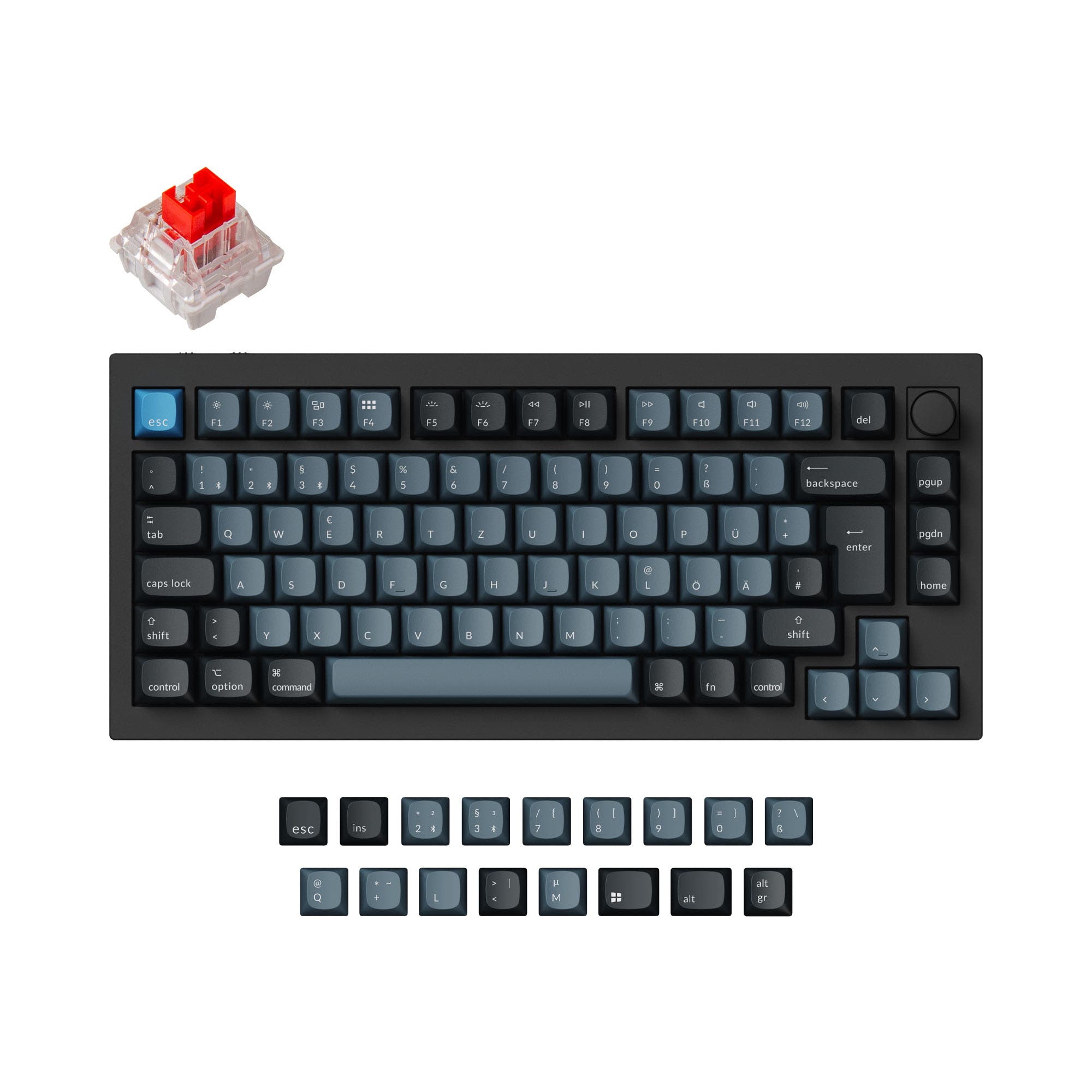
- Tri-mode connectivity includes Bluetooth, 2.4 GHz and wired USB-C.
- The 75% layout supports ANSI and ISO, with split Backspace also supported by its adaptable PCB.
- Hot-swappable PCB, VIA support and QMK support provide several customization options.
Get the
Wooting 80HE
Hall effect
Build quality in the top 35% of 75% boards under $200.
- Magnetic switches and Hall Effect are listed among its core features.
- Rapid Trigger is included.
- The listed polling rate is 8,000 Hz.
- Magnetic switches only. Standard MX switches will not fit.
- North-facing LEDs. Cherry-profile keycaps can hit the switch housing.
- No ISO layout. ISO-DE, UK, and other ISO variants are not offered.
Pick the Meletrix Zoom75 Essential Edition if wireless connectivity, ISO support, VIA/QMK customization or its LCD module are priorities. Choose the Wooting 80HE if you specifically want magnetic switches, Rapid Trigger and the higher listed polling rate, and can work within its magnetic-switch and ANSI-only compatibility limits.
The differences that matter
Skip the 40-row spec sheet. These are the specs that change how each board feels, sounds, and fits your desk.
Meletrix Zoom75 Essential Edition
Wooting 80HE
Hall effect (magnetic)
No
Yes
Adjustable actuation helps in games and not in normal typing
Rapid trigger
No
Yes
Faster resets help in games and not in normal typing
Connection
Bluetooth, 2.4 GHz, Wired
Wired
Wireless for several devices and wired for lower latency
Ergonomics
Split Backspace
Standard
Max polling rate
1,000 Hz
8,000 Hz
Higher polling helps competitive FPS and does nothing for typing
- Meletrix Zoom75 Essential Edition
- Wooting 80HE
- Performance
- 7394
- Build quality
- 9074
- Productivity
- 9173
- Customizability
- 9662
- Portability
- 7863
- Layout size: 75%
- Hot-swappable
- Sound dampening
What will you mostly use it for?
The Wooting 80HE is the gaming-oriented choice, with magnetic switches, Rapid Trigger and the higher listed polling rate. The Zoom75 leads for office use, programming and customization, with wireless connections, VIA and broader layout support. It also makes more sense for travel if wireless operation matters, although its listed weight is substantial. The Zoom75’s LCD and knob support give it the edge for content-creation workflows.
Pick the Wooting 80HE
- The Wooting 80HE has magnetic switches and Rapid Trigger.
- Its listed polling rate is 8,000 Hz, compared with 1,000 Hz for the Zoom75 in wired and 2.4 GHz modes.
Meletrix Zoom75 Essential Edition vs Wooting 80HE specs
Every tracked spec, side by side. Rows marked with a dot differ between the boards.
16 of 25 specs differ
Meletrix Zoom75 Essential Edition
Wooting 80HE
Switch options
Hall effect (magnetic)
Rapid trigger
Hot-swappable
Mount style
Sound dampening
Screw-in stabilizers
Layout size
Layout standard
Ergonomics
Knob
Display
Connection
Max polling rate
USB-C
Case material
Plate material
Keycaps
Weight
Dimensions
Typing angle
Backlight
QMK
VIA
Released
ISO layouts by store
Which stores sell ISO-DE, UK, and the other regional layouts.
Meletrix Zoom75 Essential Edition
Listed on the product, not split by store: ISO.
Wooting 80HE
No ISO layout at the stores we track.
Compare prices
Live prices from the stores we track, cheapest in-stock offer first.
Prices in USD are converted to your currency and can change at any time. KeebFinder may earn a commission when you buy through these links, at no extra cost to you.
Lowest price across stores, Amazon excluded.
- Check on Amazon
Amazon
Check price




Meletrix Zoom75 Essential Edition vs Wooting 80HE: your questions
The Wooting 80HE is the more gaming-focused option, with magnetic switches, Hall Effect and Rapid Trigger. Its listed polling rate is 8,000 Hz, compared with the Zoom75’s 1,000 Hz in wired and 2.4 GHz modes.
Yes. The Zoom75 supports Bluetooth and 2.4 GHz wireless, as well as wired USB-C. Its vendor description also lists a 2.4 GHz receiver and two Li-ion batteries in the kit contents.
No wireless connection is listed for the Wooting 80HE, which is specified as wired only. The Zoom75 is the option here with Bluetooth and 2.4 GHz connectivity.
No. The Wooting 80HE’s compatibility rule says it accepts magnetic switches only, and standard MX switches will not fit. Its hot-swap feature does not remove that limitation.
The Zoom75 lists ANSI and ISO support, and its vendor description says its adaptable PCB supports both layouts. The Wooting 80HE is ANSI only and does not offer ISO-DE, UK or other ISO variants.
Yes. The Zoom75 has an LCD module, which its vendor says can be replaced with a knob, key or badge module. Other modules are sold separately.
No screen is listed for the Wooting 80HE. The Zoom75, by contrast, includes an LCD module and supports optional replacement modules.
The Zoom75 lists VIA and QMK support, hot-swap sockets and several plate-material options, including polycarbonate, brass, aluminum, FR4, POM and carbon fiber. The Wooting 80HE is also hot-swappable, but its compatibility rule limits it to magnetic switches.
Both keyboards list hot-swappable support. The Wooting 80HE requires magnetic switches, while the Zoom75 is described as a barebones kit without switches or keycaps.
The Wooting 80HE lists an 8,000 Hz polling rate. The Zoom75 lists 1,000 Hz in wired and 2.4 GHz modes.
Its north-facing LEDs may cause Cherry-profile keycaps to hit the switch housing, according to the listed compatibility rule. Consider that fit limitation when choosing keycaps for the Wooting.
No. The Zoom75 vendor description identifies it as a barebones item and says switches and keycaps are not included. Its listed kit contents include items such as the case, PCB, LCD module, plate, stabilizers and USB-C cable.
Not sold on either?


Still torn?
Answer a few quick questions and the keyboard finder ranks 2,000+ boards by how you will actually use yours.