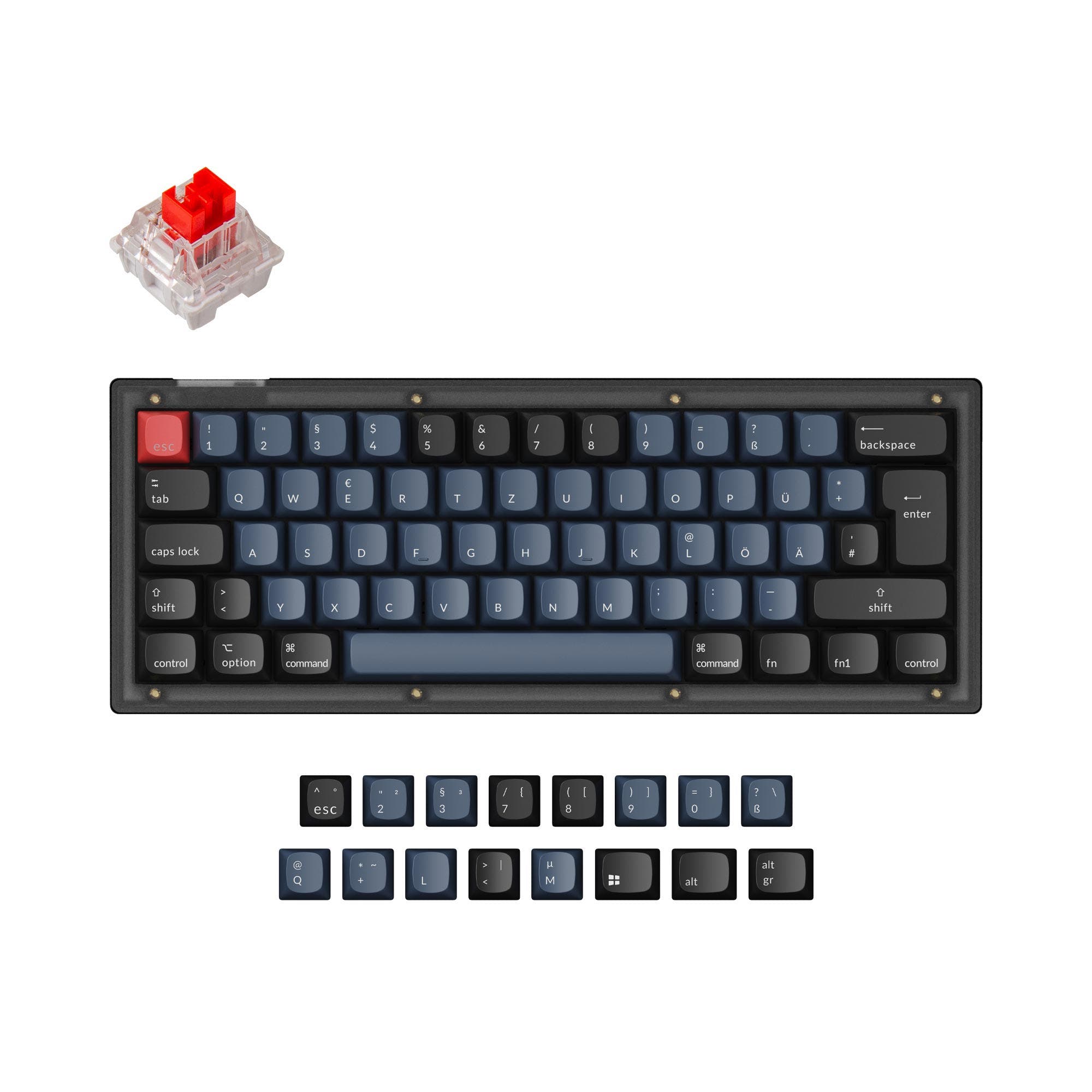
Keykobo Pixtendo Pixel67 vs Qwertykeys Neo60 Core
Get the Pixel67 for its 65% layout, QMK support and ISO-DE option, or the Neo60 Core for its lighter 1.5 kg build and wider choice of plate materials.
Prices checked Nov 27, 2026. KeebFinder may earn a commission when you buy through these links, at no extra cost to you.


Which one should you get?
Get the
Keykobo Pixtendo Pixel67
Build quality in the top 10% of 65% boards under $200.
If you want
- QMK support alongside VIA, with the vendor describing remapping, layers and macros.
- 65% layout with an integrated wrist rest and RGB indicator bar.
- Available in a fully assembled ISO-DE QWERTZ configuration.
Rules this board out
- 65% layout. No function row and no numpad.
Get the
Qwertykeys Neo60 Core
Build quality in the top 20% of 60% boards under $50.
If you want
- Approximately 1.5 kg built weight.
- Plate options include carbon fiber, aluminum, FR4, POM and plastic in the product specifications.
- An included carrying case and disassembly tool are listed with the keyboard kit.
Rules this board out
- Missing ISO-DE. The other board is sold in those layouts.
- Compact layout only. No function row, dedicated arrow keys, or numpad.
Bottom line
Get the Keykobo Pixtendo Pixel67 if you want its 65% layout, QMK support, RGB indicator bar or fully assembled ISO-DE option. Get the Qwertykeys Neo60 Core if its lighter 1.5 kg build and choice of plate materials matter more, while accepting its 60% layout and lack of an ISO-DE option.
The differences that matter
- Layout size
65%
60%
- Ergonomics
Split Backspace
Standard
- Mount style
Gasket Mount
PCB Mount
- Display
LED
None
A case display rather than a typing feature - Weight
2,870 g
1,500 g
Heavier boards stay planted and lighter ones travel
KeebFinder scores
How we score- Keykobo Pixtendo Pixel67
- Qwertykeys Neo60 Core
- Performance
- 7558
- Build quality
- 8579
- Productivity
- 8560
- Customizability
- 9472
- Portability
- 8886
What they share
- Connection: Bluetooth, 2.4 GHz, Wired
- Hot-swappable
- Case material: Aluminum
- VIA
What will you mostly use it for?
For gaming, pick the Keykobo Pixtendo Pixel67
- The Pixel67 specifies a 1000 Hz polling rate.
- Its 65% layout includes a split Backspace option, and the vendor describes it as suitable for gaming.
Keykobo Pixtendo Pixel67 vs Qwertykeys Neo60 Core specs
17 of 23 specs differ
 |  | |
| Keykobo Pixtendo Pixel67$180 | Qwertykeys Neo60 Core$49 | |
|---|---|---|
| Typing & switches | ||
| Hot-swappable | Yes | Yes |
| Mount style (differs) | Gasket Mount | PCB Mount |
| Sound dampening (differs) | Yes | No |
| Layout | ||
| Layout size (differs) | 65% | 60% |
| Layout standard (differs) | ANSI, ISO, ISO-DE | ANSI, ISO |
| Ergonomics (differs) | Split Backspace | Standard |
| Display (differs) | LED | None |
| Connectivity & battery | ||
| Connection | Bluetooth, 2.4 GHz, Wired | Bluetooth, 2.4 GHz, Wired |
| Max polling rate (differs) | 1,000 Hz | Not specified |
| Battery (differs) | Not specified | 2,200 mAh |
| USB-C | Yes | Yes |
| Build & materials | ||
| Case material | Aluminum | Aluminum |
| Plate material (differs) | Aluminum | Aluminum, CarbonFiber, FR4, Plastic, POM |
| Keycaps (differs) | ABS | Not specified |
| Weight (differs) | 2,870 g | 1,500 g |
| Dimensions (differs) | Not specified | 18 x 293 x 109 mm |
| Typing angle (differs) | 6° | 8° |
| Backlight (differs) | RGB | None |
| Firmware & software | ||
| QMK (differs) | Yes | No |
| VIA | Yes | Yes |
| N-key rollover | Yes | Yes |
| Mac & Windows (differs) | Yes | No |
| Extras | ||
| Released (differs) | 2026 | 2025 |
Compare prices
Prices in USD are converted to your currency and can change at any time. KeebFinder may earn a commission when you buy through these links, at no extra cost to you.
Lowest price across stores, Amazon excluded.
- Price now
- $49
- Lowest in range
- $49Aug 29
- Highest in range
- $49Aug 29
Price in USD
- Check on Amazon
AmazonGlobal
Check price - Extra 5% off


- Check on Amazon
AmazonGlobal
Check price - Extra 5% off

ISO layouts by store
Keykobo Pixtendo Pixel67
- Go to MonacoKeys
MonacoKeys
ISO-DE
Out of stockDoes not ship to you
Qwertykeys Neo60 Core
Listed on the product, not split by store: ISO.