Epomaker Split 65 vs Mistel MD600 V3Wireless or Wired
Choose the Epomaker Split 65 for wireless connectivity and hot-swappable switches, or the Mistel MD600 V3 if you want a compact, wired-only split keyboard.
KeebFinder may earn a commission when you buy through these links, at no extra cost to you.

4.9 · 62 reviews
from$119at Epomaker

No reviews
from$104at MK
90-day lowLowest price in 90 days
Which one should you get?
Get the
Epomaker Split 65
Hot-swappable
Build quality in the top 35% of 65% boards under $150.
- Tri-mode connectivity includes Bluetooth, 2.4 GHz, and wired operation.
- A 3000mAh battery supports wireless use.
- Hot-swappable sockets support 3- and 5-pin mechanical switches.
- South-facing LEDs. Shine-through legends stay dark, and some sculpted keycaps can clip the LED.
- 65% layout. No function row and no numpad.
Get the
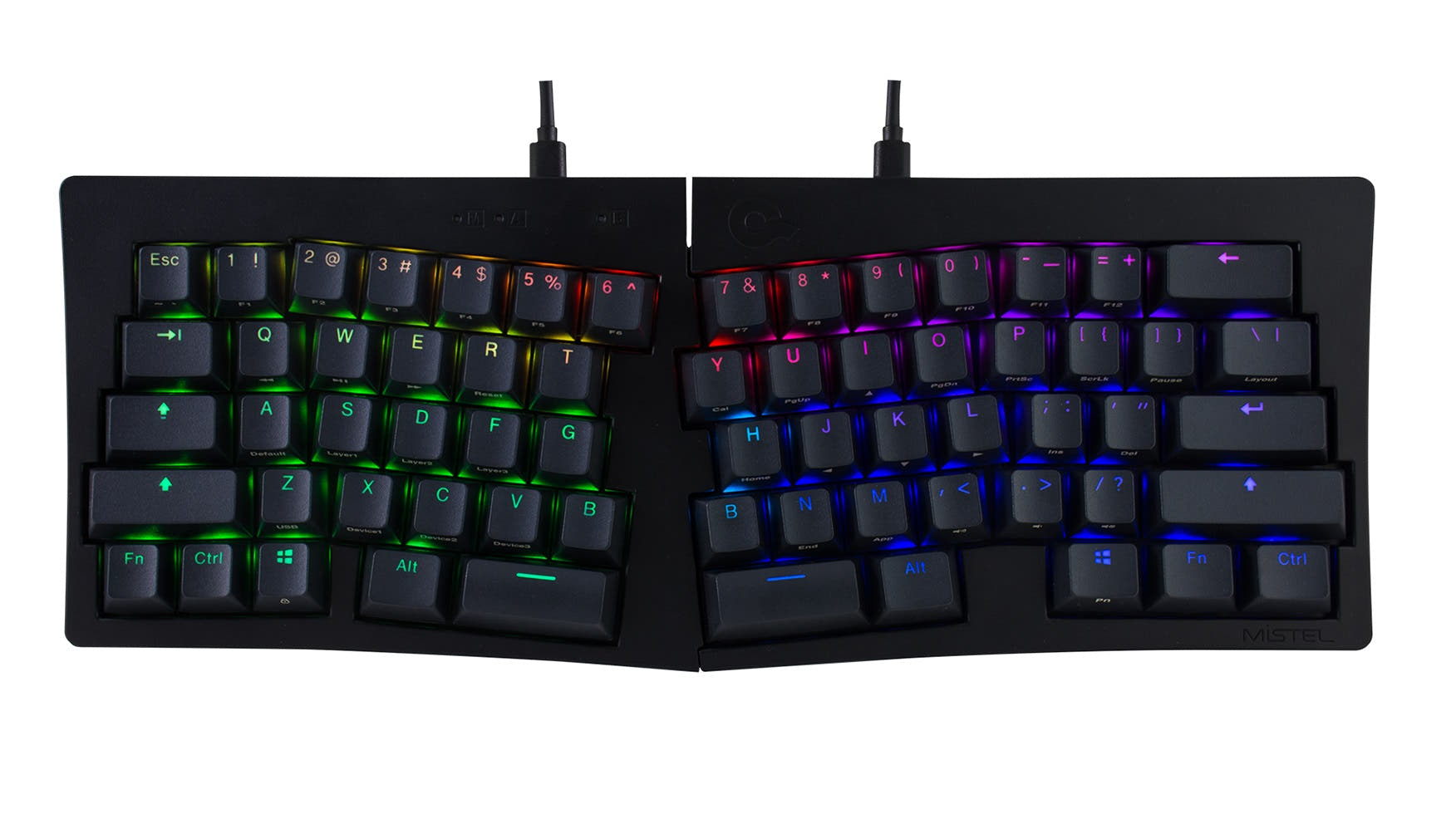
Mistel MD600 V3
Build quality in the bottom 15% of 60% boards under $150.
- The 60% split form factor offers a compact layout.
- The vendor listing names Cherry MX Brown, Blue, Red, and Silent Red switch options.
- PBT double-shot keycaps are listed.
- Switches are soldered. Swapping them means soldering.
- Compact layout only. No function row, dedicated arrow keys, or numpad.
For most buyers who want a split keyboard with flexible desk placement and room to change switches, choose the Epomaker Split 65. Its Bluetooth and 2.4 GHz connectivity, hot-swap support, and QMK/VIA support are the key advantages. Consider the Mistel MD600 V3 if a 60% wired-only layout and its listed Cherry switch options better match your setup.
The differences that matter
Skip the 40-row spec sheet. These are the specs that change how each board feels, sounds, and fits your desk.
Epomaker Split 65
Mistel MD600 V3
Layout size
65%
60%
Connection
Bluetooth, 2.4 GHz, Wired
Wired
Wireless for several devices and wired for lower latency
Hot-swappable
Yes
No
Switch changes without soldering
Case material
ABS, Metal
ABS, Plastic
Switch options
Linear
Clicky, Linear, Silent, Tactile
- Epomaker Split 65
- Mistel MD600 V3
- Performance
- 7555
- Build quality
- 7245
- Productivity
- 8860
- Customizability
- 8652
- Portability
- 8995
- Ergonomics: Split
- Max polling rate: 1,000 Hz
- Plate material: Plastic
- Keycaps: PBT
What will you mostly use it for?
The Split 65 leads across the listed categories because it combines wireless connections with hot-swap and programmable-key support. For gaming, its 1000 Hz polling rate and N-Key Rollover are also specified. The MD600 V3's clearest distinctions are its compact 60% split format and listed choice of Cherry switch types, including Silent Red. Neither keyboard has a dedicated function row, and the MD600 V3 also lacks dedicated arrow keys.
Pick the Epomaker Split 65
- The Split 65 supports wired, 2.4 GHz, and Bluetooth connections, while the MD600 V3 is wired-only.
- The Split 65 lists a 1000 Hz polling rate and N-Key Rollover.
- The Split 65 has linear switches listed in its metadata.
Epomaker Split 65 vs Mistel MD600 V3 specs
Every tracked spec, side by side. Rows marked with a dot differ between the boards.
12 of 24 specs differ
Epomaker Split 65
Mistel MD600 V3
Switch options
Hot-swappable
Mount style
Sound dampening
Layout size
Layout standard
Ergonomics
Display
Connection
Max polling rate
Battery
USB-C
Case material
Plate material
Keycaps
Weight
Dimensions
Typing angle
Backlight
QMK
VIA
N-key rollover
Mac & Windows
Released
Compare prices
Live prices from the stores we track, cheapest in-stock offer first.
Prices in USD are converted to your currency and can change at any time. KeebFinder may earn a commission when you buy through these links, at no extra cost to you.
Lowest price across stores, Amazon excluded.



Epomaker Split 65 vs Mistel MD600 V3: your questions
Yes. It supports Bluetooth and 2.4 GHz wireless, as well as a wired connection, and has a 3000mAh battery. The Mistel MD600 V3 is listed as wired-only.
No wireless connection is listed for the MD600 V3, and its metadata specifies wired-only connectivity. Its vendor description lists Type-C connectivity.
The Epomaker Split 65 is hot-swappable and supports 3- and 5-pin mechanical switches. The Mistel MD600 V3 has soldered switches, so changing them requires soldering.
The Split 65 lists QMK and VIA support. Epomaker describes these as options for remapping keys and creating macros.
Yes, the vendor description lists macro functionality for the MD600 V3. It does not list QMK or VIA support.
The vendor listing names Cherry MX Brown, Cherry MX Blue, Cherry MX Red, and Cherry MX Silent Red options. The product metadata categorizes its switch types as clicky, tactile, linear, and silent.
The Split 65 has a listed 1000 Hz polling rate, N-Key Rollover, and wired or 2.4 GHz connection options. The MD600 V3 is wired-only, and its listed features include RGB and macro functionality.
The Split 65 is a 65% ANSI keyboard with 68 keys and an adjustable split layout. Its compatibility notes specify that it has no function row or numpad.
The MD600 V3's compact-layout compatibility rule says it has no dedicated arrow keys. It also lacks a function row and numpad.
Both keyboards list PBT keycaps. The Mistel vendor description specifies double-shot PBT, while Epomaker lists Cherry-profile, dye-sublimated PBT keycaps for the Split 65.
Yes, the Split 65 has per-key, south-facing RGB lighting. Epomaker's compatibility note warns that shine-through legends stay dark and some sculpted keycaps can clip the LEDs.
The Split 65 lists sound dampening, including Poron sandwich foam and an IXPE switch pad. The MD600 V3 has a Silent Red switch option in the vendor listing, but the descriptions do not establish how loud either complete keyboard is.
Not sold on either?



Still torn?
Answer a few quick questions and the keyboard finder ranks 2,000+ boards by how you will actually use yours.