$69
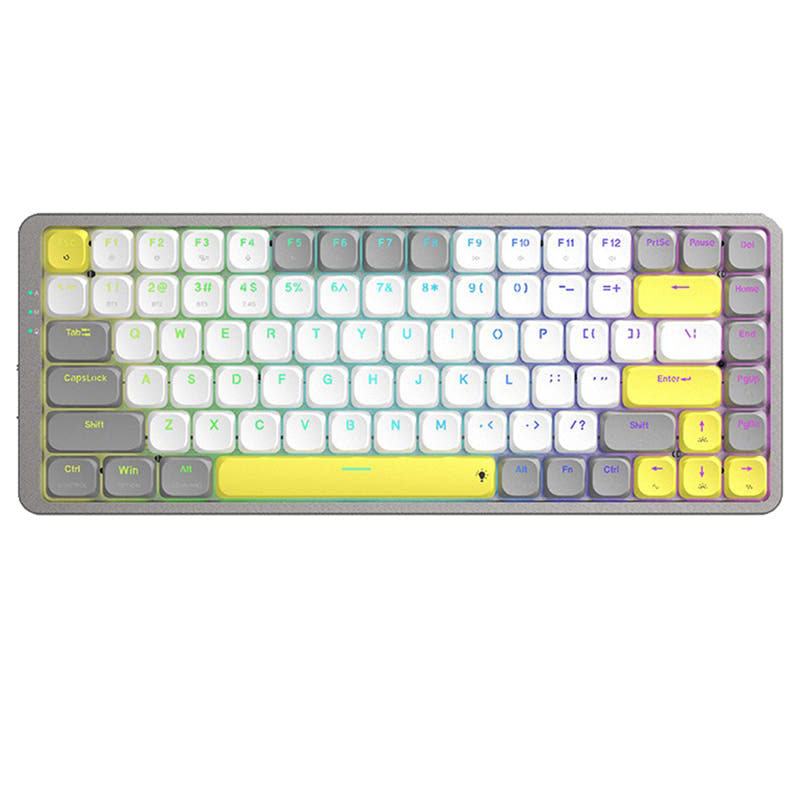
Redragon TL84
75%,
Hotswap,
Wireless,
Wired,
RGB,
Alu case
This comparison is for buyers deciding between a slim, travel-friendly low-profile mechanical keyboard and a heavier, more customizable standard-height board. The K1 V6 offers an 80% TKL layout with ultra-slim Keychron Milk POM switches, making it one of the thinnest wireless mechanical keyboards available. The K2 Pro presents a 75% layout with a steel plate, screw-in PCB stabilizers, and standard MX-style switch compatibility, appealing to enthusiasts who value build quality and modding potential. Both keyboards support QMK/VIA firmware and wireless connectivity, but they cater to different priorities in typing experience and portability.
84 Overall/ Value 84.2Build Quality 78.4Customizability 88.3Performance 81.5Productivity 79.9Portability 72.9 | 94 Overall/ Value 93.6Build Quality 89.5Customizability 96.0Performance 81.6Productivity 94.8Portability 79.5 | Select a keyboard to compare |
5.0 stars (2 reviews) | 4.9 stars (16 reviews) | |
|
| |
Scores
| Scores
| |
Name Keychron K1 V6 | Name Keychron K2 Pro | |
Release year 2024 | Release year 2022 | |
Switch Options Linear, Tactile, Clicky | Switch Options Linear, Tactile, Clicky | |
Profile Low Profile | Profile Normal Profile | |
Hot Swappable | Hot Swappable | |
Layout Size 80% | Layout Size 75% | |
Layout Standard ISO, ISO-UK, ISO-DE, ISO-SW, ISO-Nordic, ANSI | Layout Standard ISO, JIS, ANSI, ISO-DE, ISO-ES, ISO-FR, ISO-SW, ISO-UK | |
Layout Ergonomics Normal | Layout Ergonomics Normal | |
Knob Support | Knob Support | |
Display Support | Display Support | |
Mac/Win Support | Mac/Win Support | |
Multi-Media Keys | Multi-Media Keys | |
USB-C | USB-C | |
USB passthrough | USB passthrough | |
Connection Bluetooth, Wired, Wireless | Connection Bluetooth, Wired, Wireless | |
Polling Rate 1000 Hz | Polling Rate 1000 Hz | |
Battery capacity 2000 mAh | Battery capacity 4000 mAh | |
Hall Effect Support | Hall Effect Support | |
QMK Support | QMK Support | |
VIA Support | VIA Support | |
VIAL Support | VIAL Support | |
N-Key Rollover | N-Key Rollover | |
Rapid Trigger | Rapid Trigger | |
Mount Style Top Mount | Mount Style Tray Mount | |
Screw in Stabilizers | Screw in Stabilizers | |
Sound Dampening | Sound Dampening | |
Backlight Rgb, North-face, White | Backlight Rgb, South-face, White, White South-face | |
Case Colors | Case Colors | |
Case Material ABS, Aluminum | Case Material Aluminum, Plastic, ABS | |
Keycaps Material ABS | Keycaps Material ABS, PBT | |
Dimensions 25 x 346 x 119 mm | Dimensions 25 x 317 x 122 mm | |
Weight 596g | Weight 1070g |
Your choice hinges on form factor priority. If you value a slim, lightweight keyboard for travel and a low-profile typing feel, the K1 V6 is the clear winner, despite its limited switch options and smaller battery. If you prioritize build quality, extensive modding potential, and a standard typing experience, the K2 Pro is the better investment, accepting its heavier weight. Both are excellent QMK/VIA keyboards, but they serve different segments of the mechanical keyboard market.
The K1 V6 wins for travel due to its low weight and ultra-slim design, and edges ahead for gaming thanks to its higher wired polling rate and lighter feel. The K2 Pro dominates in office and content creation use cases with its larger battery, stable build, and sound dampening. For programming, both keyboards tie given their shared QMK/VIA support and layout preferences being subjective. Modders will clearly prefer the K2 Pro for its standard MX switch compatibility, barebones option, and enthusiast-grade stabilizers.
You might also like similar products in that price range:


