Epomaker Split70 vs Keychron Q11Wireless or Metal
Choose the Split70 for tri-mode wireless and a lighter ABS gasket-mounted build, or the Q11 for its aluminum body and wider layout selection.
KeebFinder may earn a commission when you buy through these links, at no extra cost to you.

4.0 (15)4.0 · 15 reviews
from$98at Epomaker
90-day lowLowest price in 90 days
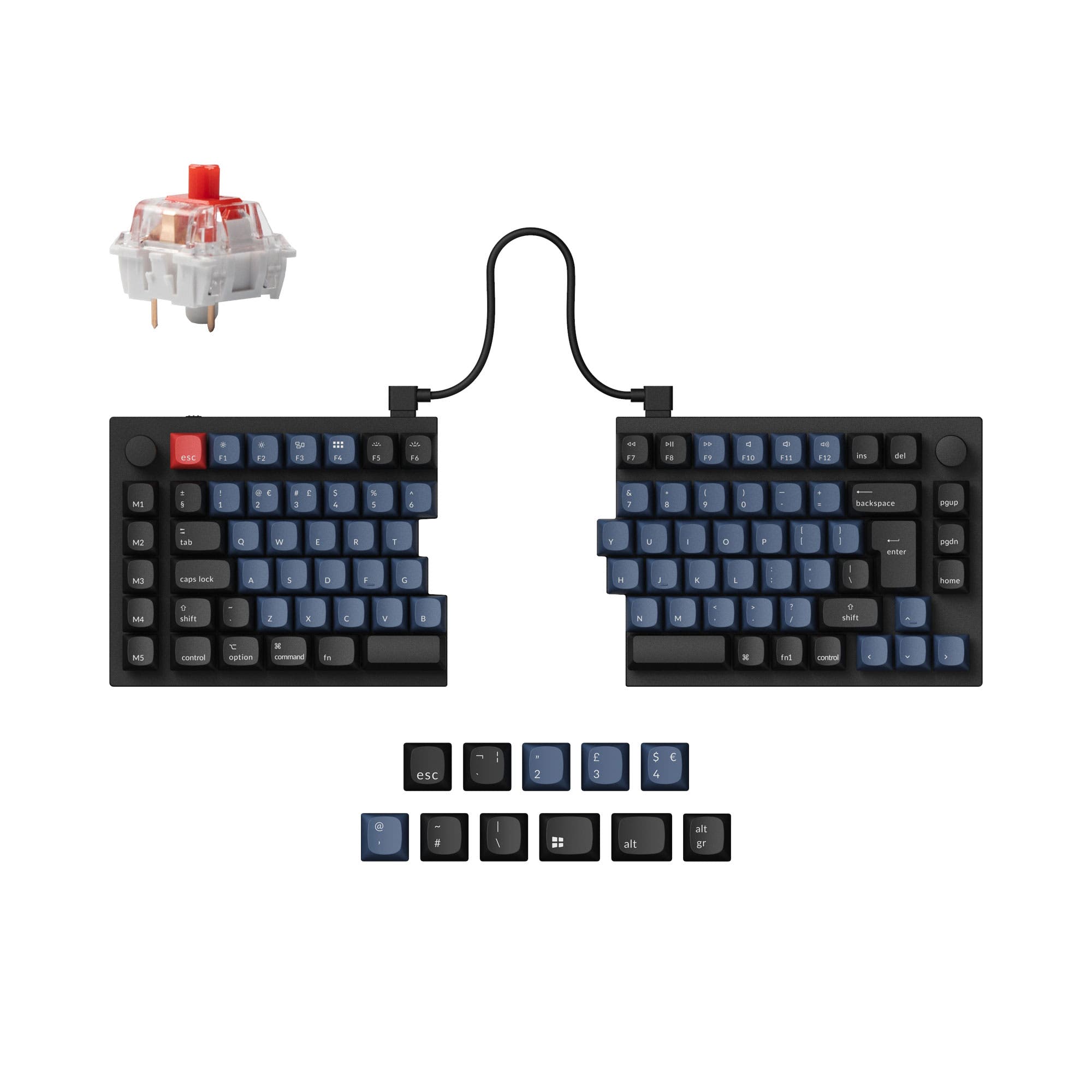
4.7 (13)4.7 · 13 reviews
from$184at Keychron
Which one should you get?
Get the
Epomaker Split70
- Tri-mode connectivity: Bluetooth, 2.4 GHz, and wired USB-C.
- Gasket mount with a polycarbonate plate and five vendor-described sound-dampening layers.
- PBT Cherry-profile keycaps with dye-sublimated legends.
- South-facing LEDs. Shine-through legends stay dark, and some sculpted keycaps can clip the LED.
- No ISO layout. ISO-DE, UK, and other ISO variants are not offered.
Get the
Keychron Q11
- All-metal aluminum case with a steel or aluminum plate listed in the specifications.
- Supports ANSI, ISO, ISO-DE, ISO-Nordic, ISO-UK, and JIS layout standards.
- Hot-swappable PCB supports 3-pin and 5-pin MX switches.
- South-facing LEDs. Shine-through legends stay dark, and some sculpted keycaps can clip the LED.
Choose the Epomaker Split70 if wireless flexibility, a lighter listed weight, and its gasket-mounted ABS-and-polycarbonate build are priorities. Choose the Keychron Q11 if you need one of its listed ISO layouts, want an aluminum body, or value its barebones option and programmable encoder. Both provide split ergonomics, hot-swapping, QMK, VIA, and a knob.
The differences that matter
Skip the 40-row spec sheet. These are the specs that change how each board feels, sounds, and fits your desk.
Epomaker Split70
Keychron Q11
Connection
Bluetooth, 2.4 GHz, Wired
Wired
Wireless for several devices and wired for lower latency
Case material
ABS
Aluminum
Switch options
Linear
Clicky, Linear, Tactile
Mount style
Gasket Mount
Plate Mount, Tray Mount
Weight
890 g
1,186 g
Heavier boards stay planted and lighter ones travel
- Epomaker Split70
- Keychron Q11
- Performance
- 7868
- Build quality
- 7888
- Productivity
- 9397
- Customizability
- 9198
- Portability
- 8873
- Hot-swappable
- Ergonomics: Split
- Max polling rate: 1,000 Hz
- Knob
- QMK
- VIA
What will you mostly use it for?
The Split70 is the more convenient pick for gaming setups that benefit from wireless connections and for carrying between workspaces, though both list a 1000 Hz polling rate. The Q11 has the edge for office users who need an ISO option, and for builders who want a barebones purchase path. Programming is a close match because both support QMK, VIA, and hot-swapping. The Q11's programmable encoder makes its creative-workflow controls more explicitly documented.
Pick the Epomaker Split70
- The Split70 supports Bluetooth, 2.4 GHz, and wired connections, while the Q11 is wired only.
- Epomaker lists 3 ms latency in wired mode and 5 ms in 2.4 GHz mode for the Split70; both keyboards list a 1000 Hz polling rate.
What owners say
Ratings and quotes collected from verified store reviews, including the critical ones.
Epomaker Split70
15 owner reviews
“Check out my full review - https://dezdoes.com/epomaker-split-70-the-learning-curve-and-triumph-of-split-ergonomics/”
“i bet its a great product but i never got it because there was an issue with the destination info.. im kinda down eighty bucks and a keyboard.. im working my butt off so i can try to get a new one”
Keychron Q11
13 owner reviews
“I wish that the "launcher" app had more layer options and more layer options for the RGB, but that's ok. I have a Moonlander as well and I recommend the Q11 to almost everyone, the ortholinear boards take a lot of relearning for most people to type on.”
Epomaker Split70 vs Keychron Q11 specs
Every tracked spec, side by side. Rows marked with a dot differ between the boards.
13 of 26 specs differ
Epomaker Split70
Keychron Q11
Switch options
Hot-swappable
Mount style
Sound dampening
Screw-in stabilizers
Layout standard
Ergonomics
Knob
Display
Media keys
Connection
Max polling rate
Battery
USB-C
Case material
Plate material
Keycaps
Weight
Dimensions
Typing angle
Backlight
QMK
VIA
N-key rollover
Mac & Windows
Released
ISO layouts by store
Which stores sell ISO-DE, UK, and the other regional layouts.
Epomaker Split70
No ISO layout at the stores we track.
Keychron Q11
Keychron
ISO-DE, ISO-UK, ISO-Nordic
Out of stockShips to you
Keychron (DE)
ISO-DE, ISO-UK
Out of stockDoes not ship to you
Compare prices
Live prices from the stores we track, cheapest in-stock offer first.
Prices in USD are converted to your currency and can change at any time. KeebFinder may earn a commission when you buy through these links, at no extra cost to you.
Lowest price across stores, Amazon excluded.





Epomaker Split70 vs Keychron Q11: your questions
Yes. It supports Bluetooth, 2.4 GHz, and wired USB-C connections. Its battery is listed at 3000mAh.
No. The Q11 is listed as wired-only, with a Type-C wired connection and 1000 Hz polling rate.
The Epomaker Split70 is listed at 890 g. The fully assembled Keychron Q11 is listed at 1186 g.
The Q11 is listed with ISO, ISO-DE, ISO-Nordic, and ISO-UK options, alongside ANSI and JIS. The Split70 compatibility rules say ISO layouts are not offered.
Both keyboards are hot-swappable. Epomaker describes the Split70 as compatible with most 3-pin and 5-pin mechanical switches, while Keychron specifies 3-pin and 5-pin MX switches for the Q11.
Both are listed with QMK and VIA support. Keychron also describes using its Launcher web app for key remapping and macros.
The Split70 supports 2.4 GHz wireless as well as Bluetooth and wired use, while the Q11 is wired only. Epomaker lists 5 ms latency in 2.4 GHz mode and 3 ms in wired mode for the Split70.
Keychron describes the Q11's aluminum rotary encoder as programmable through VIA for keys and macros. Its examples include zooming, adjusting volume, and selecting video clips or photos.
Both have south-facing RGB, and both compatibility rules warn that shine-through legends stay dark. The Q11 vendor describes its included PBT keycaps as non-shine-through.
Yes. It has a listed 3000mAh rechargeable battery, and Epomaker lists up to 260 hours with the backlight off. The vendor also lists up to 11 hours with the backlight on.
Keychron says the two halves can be linked with a bridge cable to use the Q11 as a non-split keyboard. It also describes using either half on its own.
The Epomaker Split70 is listed with a gasket mount and polycarbonate plate. The Keychron Q11 is listed with tray mount and a steel or aluminum plate.
Not sold on either?


Still torn?
Answer a few quick questions and the keyboard finder ranks 2,000+ boards by how you will actually use yours.